
Building a privacy programme
In this lesson you will:
- Describe the building blocks of a privacy programme
- Set up governance, roles and a policy framework
- Run the programme as a continuous plan-do-check-act cycle
- Measure programme maturity and report it to leadership
Compliance with privacy law is not a project with an end date. Products, vendors, laws and threats keep changing, so organisations need a programme: a standing set of people, processes and tools that keeps personal data handling lawful and trustworthy over time.
1. The building blocks
A privacy programme rests on a foundation of governance and is held up by a few pillars of operational work.
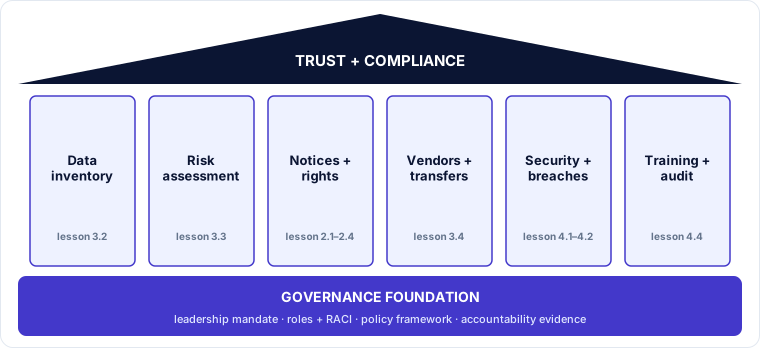
| Building block | What it delivers | Lesson |
|---|---|---|
| Governance and policies | Leadership mandate, roles, rules | This lesson |
| Data inventory and records | Knowing what data you have and why | 3.2 |
| Risk assessment and privacy by design | Catching problems before launch | 3.3 |
| Third parties and transfers | Control over data that leaves the organisation | 3.4 |
| Notices, consent and rights | Transparency and individual control | 2.1–2.4 |
| Security and breach response | Protection and fast, lawful reaction | 4.1–4.2 |
| Training, monitoring and audit | Awareness, assurance, improvement | 4.4 |
2. Governance and roles
Leadership mandate. A board or executive committee approves the privacy strategy and policy, funds the programme and receives regular reports. Without this, privacy becomes "the legal team's problem" and loses every trade-off.
Clear roles. A typical structure:
- Accountable executive (for example the chief risk officer or general counsel): owns privacy risk at leadership level.
- DPO or privacy lead: designs the programme, advises, monitors compliance, handles regulators.
- Privacy champions in business units: first point of contact, keep local records current.
- Process and system owners: accountable for the personal data in their processes.
- Security, legal, HR, procurement, IT: deliver their parts of the controls.
Many organisations use a three lines model: business owners manage privacy risk day to day (first line), the privacy function sets standards and oversees (second line), and internal audit gives independent assurance (third line).
A RACI chart makes ownership explicit for key activities.
| Activity | Business owner | Privacy lead | Security | Legal | Internal audit |
|---|---|---|---|---|---|
| Maintain record of processing | R | A | C | I | I |
| Run a DPIA | R | A | C | C | I |
| Respond to a rights request | R | A | C | C | I |
| Notify a breach | C | R | R | A | I |
| Audit the programme | C | C | C | I | A/R |
R = responsible, A = accountable, C = consulted, I = informed.
3. The policy framework
Policies turn principles into rules. Keep the hierarchy simple:
- Privacy policy (internal): high-level commitments approved by leadership.
- Standards: specific, mandatory requirements, such as retention, consent records, data classification or vendor assessment.
- Procedures and playbooks: step-by-step instructions, such as handling a rights request or notifying a breach.
- Guidelines and templates: helpful aids, such as DPIA templates, notice wording, clause libraries.
Do not confuse the internal privacy policy with the external privacy notice (lesson 2.2): one tells staff what to do, the other tells individuals what you do.
4. Running it as a cycle
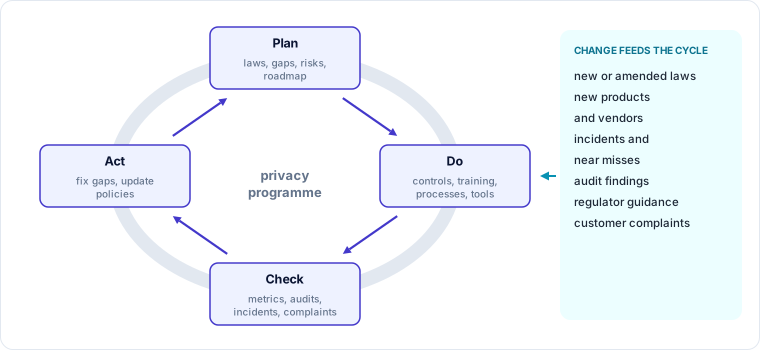
A programme improves continuously through plan-do-check-act:
- Plan: assess applicable laws, gaps and risks; set priorities and a roadmap.
- Do: implement controls, training, processes and tools.
- Check: monitor metrics, run audits, review incidents and complaints.
- Act: fix gaps, update policies, respond to new laws and products.
🔐 Privacy lens
Privacy and security programmes should share plumbing: one asset inventory, one risk register, one incident process, one vendor-assessment workflow. Duplicated processes drift apart and leave gaps attackers and auditors both find.
5. Measuring maturity
Maturity models help set targets and show progress. A five-level scale is common:
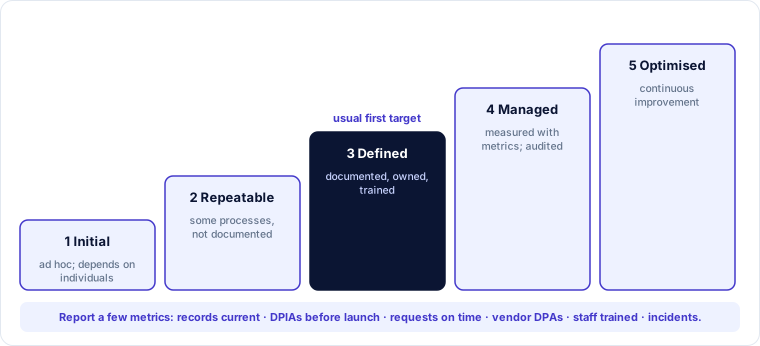
Useful metrics for leadership: percentage of processing activities with a current record; DPIAs completed before launch; rights requests closed within deadline; vendors with signed data-processing terms; staff trained; breaches and near misses; regulator complaints; time to contain incidents.
Worked example — a first-year roadmap for a mid-size insurer
| Quarter | Focus | Outcome |
|---|---|---|
| Q1 | Mandate and gap assessment | Board-approved privacy policy; DPO appointed; gap report against applicable laws |
| Q2 | Know your data | Records of processing for the 40 main activities; data map of claims and underwriting |
| Q3 | Fix high risks | DPIAs for pricing models and health data; vendor contracts updated; rights-request workflow live |
| Q4 | Embed and measure | Training for all staff; breach playbook tested in a tabletop; first metrics report to the board |
Key takeaways
- A privacy programme is permanent: governance foundation plus operational pillars.
- Leadership mandate, clear roles, three lines and a RACI make ownership real.
- Policies, standards, procedures and guidelines form a simple hierarchy; the internal policy is not the external notice.
- Run the programme as plan-do-check-act and measure maturity with a few meaningful metrics.
Self-check
- Who is in the first line for privacy risk in a three-lines model?
- What is the difference between a privacy policy and a privacy notice?
- Name three metrics you would report to the board.