
Sensitive data, children, marketing and profiling
In this lesson you will:
- Apply the extra conditions that protect sensitive personal data
- Handle children's data, including age assurance and parental consent
- Run direct marketing that respects opt-in and opt-out rules
- Recognise profiling and automated decisions, and the safeguards they need
Four areas cause a large share of privacy complaints and fines: sensitive data, children's data, direct marketing and automated decisions about people. Each adds rules on top of the basics from lessons 2.1 to 2.3.
1. Sensitive personal data
Processing sensitive data (lesson 1.1) usually needs two things: a normal legal basis and an additional condition, such as explicit consent, employment or social-security law, vital interests, substantial public interest, healthcare or legal claims. Several US states require opt-in consent for sensitive data, and California gives consumers a right to limit its use.
Practical safeguards:
- collect it only where clearly necessary, and say so in the notice
- separate it from ordinary data, with tighter access control and logging
- run a risk assessment (lesson 3.3) before large-scale processing
- watch for inferred sensitive data: an algorithm that infers pregnancy from shopping or health conditions from app usage is processing sensitive data even if nobody typed it in
2. Children's data
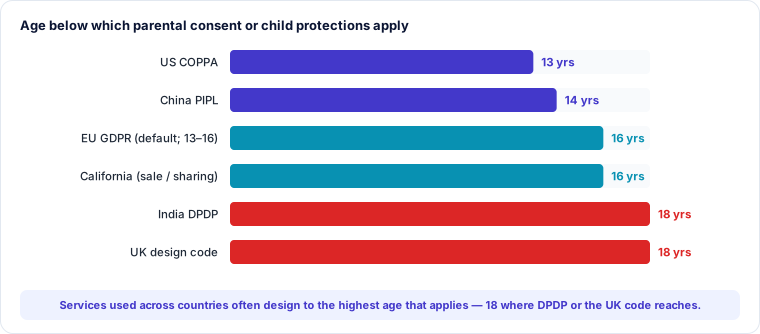
Children are less aware of risks and more open to manipulation, so laws protect them more strongly. Ages differ:
| Law | Who counts as a child for consent | Key rules |
|---|---|---|
| India DPDP | Under 18 | Verifiable parental consent; no tracking, behavioural monitoring or targeted advertising directed at children; limited exemptions set by the Rules |
| EU GDPR | Under 16 by default; countries may lower to 13 | Parental consent for online services offered directly to children below the national age |
| US COPPA | Under 13 | Verifiable parental consent for online services directed at children or with actual knowledge |
| California | Under 16 | Opt-in to sale or sharing (parent for under-13s) |
| China PIPL | Under 14 | Treated as sensitive; parental consent and special rules |
| UK Age Appropriate Design Code | Under 18 | High-privacy defaults, no nudging, profiling off by default |
Age assurance means working out whether a user is a child, in proportion to the risk: self-declaration for low-risk services, age estimation or verification through trusted credentials (for example, government-backed digital lockers) where risks are higher. Collecting more identity data than necessary to check age creates its own privacy risk.
Verifiable parental consent means taking reasonable steps to confirm that the consenting adult is really the parent or guardian, such as checking against identity details already held or a verified token.
🔐 Privacy lens
Design for children by default where you cannot reliably tell ages apart: high-privacy settings, no precise location, no public profiles, no behavioural advertising. It is usually cheaper than bolting protections on later.
3. Direct marketing
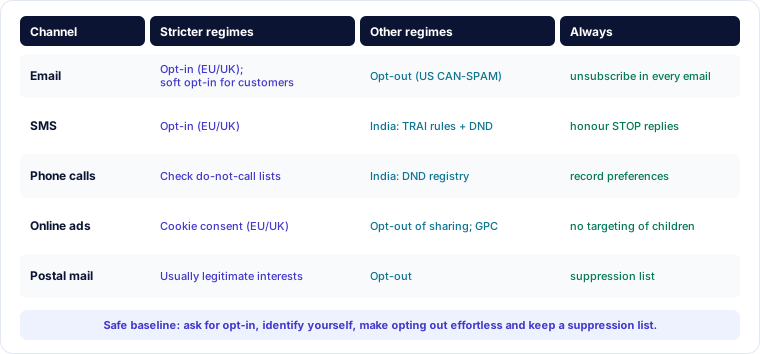
Marketing rules sit in privacy laws and in electronic-communications or consumer laws.
- Email and SMS: the EU and UK require prior opt-in consent for individuals, with a "soft opt-in" exception for similar products sold to existing customers who were given a chance to refuse. The US CAN-SPAM Act allows email marketing with a working opt-out. India regulates calls and SMS through TRAI's commercial-communication rules and the national Do Not Disturb registry.
- Phone calls: check do-not-call registries before calling.
- Targeted online advertising: often relies on cookies and tracking (lesson 4.3); US state laws give an opt-out of "sharing" for cross-context behavioural advertising and require honouring Global Privacy Control signals in several states.
- Always: honour opt-outs quickly, keep a suppression list so people are not re-added, and identify yourself.
4. Profiling and automated decisions
Profiling is automated processing to evaluate or predict aspects of a person: interests, creditworthiness, reliability, health, location. It is common and often lawful, but it must be transparent and fair.
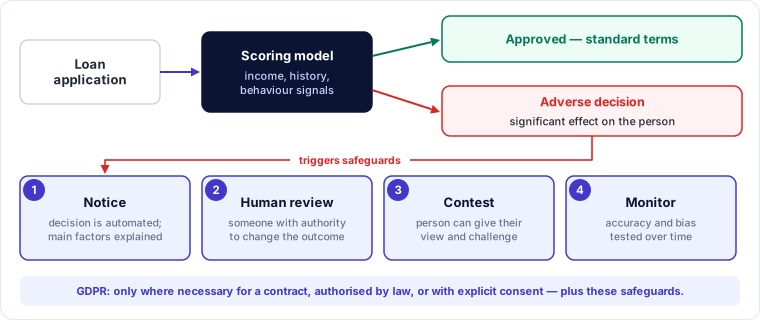
Solely automated decisions with legal or similarly significant effects, such as refusing a loan, rejecting a job application or setting an insurance price with no meaningful human involvement, carry extra rules. GDPR allows them only where necessary for a contract, authorised by law, or with explicit consent, and requires safeguards. Several US states give opt-outs from profiling that produces significant decisions, and PIPL requires transparency and an option to refuse personalised targeting.
Safeguards for significant automated decisions:
- tell people the decision is automated, the logic involved and the likely consequences
- offer meaningful human review by someone with authority to change the outcome
- let people express their view and contest the decision
- test models for accuracy and bias, and monitor outcomes over time
Worked example — a children's learning app
| Area | Decision |
|---|---|
| Audience | Users aged 8 to 16 in India, the EU and the US |
| Age | Design to under-18 rules everywhere; ask age at sign-up with neutral wording |
| Consent | Parent account required; parent verified against a trusted credential, such as a government-backed digital locker token; child cannot change privacy settings alone |
| Data collected | First name, class, progress; no photos, no precise location, no contacts |
| Profiling | Learning-level recommendations only; no behavioural advertising; no tracking across other sites |
| Marketing | Emails go to parents only, with opt-in; none to children |
| Notices | Child-friendly first layer with pictures; full notice for parents |
| Review | Risk assessment signed off before launch; reviewed when features change |
Key takeaways
- Sensitive data needs a legal basis plus an extra condition, tighter controls and attention to inferred data.
- Child ages range from 13 to 18 across laws; DPDP sets 18 with verifiable parental consent and bans tracking and targeted ads directed at children.
- Marketing rules vary by channel; opt-in, suppression lists and effortless opt-out are the safe baseline.
- Significant automated decisions need transparency, human review, a way to contest and bias monitoring.
Self-check
- A shopping app infers that a customer is pregnant. Why does that matter?
- What does DPDP prohibit in relation to children, beyond requiring parental consent?
- Name two safeguards for a solely automated credit decision.