
Post-exercise reporting and evaluating BC documentation and capabilities (8.6)
In this lesson you will:
- Write post-exercise reports that meet ISO 22301 and regulatory expectations
- Track exercise actions to closure and verify their effectiveness
- Explain the evaluation requirements of ISO 22301 clause 8.6
- Evaluate supplier capabilities and legal and regulatory compliance as part of the BCMS
An exercise that produces no changes has wasted everyone's time. This lesson covers turning exercise results into improvement, and the broader clause 8.6 requirement to keep evaluating whether the BIA, risk assessment, strategies, solutions and plans are still fit for purpose.
1. Post-exercise reports
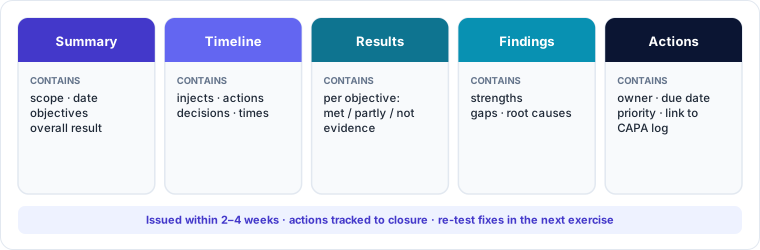
ISO 22301 requires formalised post-exercise reports containing outcomes, recommendations and actions to implement improvements. A useful report has:
| Section | Content |
|---|---|
| Summary | Scope, date, participants, objectives, overall result |
| Timeline | Injects, actions, decisions and times, from the scribe's log |
| Results by objective | Met, partly met or not met, with evidence, not opinion |
| Findings | Strengths to keep; gaps, with root causes |
| Actions | Owner, due date, priority; linked to the corrective action log |
| Plan updates | Documents to change as a result |
Practical rules:
- Hold a hot debrief immediately and a cold debrief a few days later, once people have reflected.
- Issue the report within two to four weeks while memories are fresh.
- Write findings about systems and processes, not individuals.
- Rate findings by severity so that critical ones (for example "RTO not achievable") reach the steering group and board quickly.
- Share relevant parts with suppliers and customers who took part.
2. Closing the loop
Exercise actions follow the same discipline as audit findings (Module 8):
- each action goes into the corrective action log with an owner and due date;
- progress is reviewed at steering meetings;
- closure needs evidence, such as an updated plan, changed configuration or retraining record;
- effectiveness is verified, ideally by re-testing in the next exercise. Tarang's month-12 drill re-tested the month-9 findings.
Track a programme-level metric such as "exercise actions closed on time" (an objective from Module 2) and report it to management review.
3. Evaluating BC documentation and capabilities (8.6)
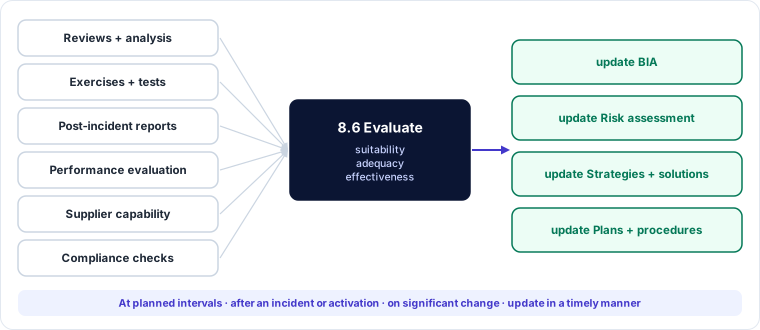
Clause 8.6 requires the organisation to:
- evaluate the suitability, adequacy and effectiveness of its BIA, risk assessment, strategies, solutions, plans and procedures;
- do so through reviews, analysis, exercises, tests, post-incident reports and performance evaluations;
- evaluate the business continuity capabilities of relevant partners and suppliers;
- evaluate compliance with applicable legal and regulatory requirements, industry good practice and conformity with its own BC policy and objectives;
- update documentation and procedures in a timely manner.
Evaluations are conducted at planned intervals, after an incident or activation, and when significant changes occur.
The three words mean different things:
- Suitable: does it fit the organisation now? (New products, new suppliers, new regulations.)
- Adequate: is it complete enough? (All critical operations covered? All scenarios?)
- Effective: does it work? (Exercise and incident evidence.)
4. Evaluating suppliers and compliance
Supplier capability. For critical suppliers, evaluate at least yearly:
- their latest DR or BC test results against contracted RTO and RPO;
- incidents during the year and how they were handled;
- changes in their sub-contractors or hosting;
- participation in your exercises and the findings;
- certificates and independent reports (ISO 22301, ISO 27001, SOC 2).
Compliance. Use the regulatory register (Lesson 2.1) as a checklist:
- were drills done at required frequencies?
- were incidents reported within deadlines?
- are board approvals of tolerances and policies current?
- do customer contract obligations (test reports, notification) match practice?
Record the evaluation results; they are inputs to management review (Module 8).
Auditor lens
Auditors trace an exercise finding from the report to the corrective action log, to the evidence of closure, and to the re-test. For clause 8.6 they look for a documented evaluation, typically annual, covering all the listed elements, and check that it led to updates. "BIA last reviewed two years ago despite two new products" is a common nonconformity.
Case study — Tarang Ledger: annual 8.6 evaluation (month 11)
Anil compiles the evaluation for management review:
| Element | Evidence | Conclusion | Update |
|---|---|---|---|
| BIA | New product (insurance premium collection) launched month 8 | Not suitable: product not in BIA | BIA extended; Tier 2 |
| Risk assessment | Clean-room test exceeded 12 h target | Partly effective | S-01 residual risk re-rated; investment in incremental reconciliation |
| Strategies and solutions | Region failover drill met RTO; clean room missed target | Mostly effective | Action plan; re-test month 15 |
| Plans | Walkthroughs and drills; fail-back gap found | Adequate after updates | R-3 fail-back runbook written |
| Suppliers | PA-1 outage (Lesson 6.5); PA-1 DR test report not received | Not adequate for PA-1 | Contract amendment: annual DR report and joint test |
| Compliance | Customer notice met 2 h in the cyber simulation; one real SEV-2 notice took 2 h 20 min | Partly compliant | Notification automated from the incident tool |
Actions go into the corrective action log; the evaluation becomes an input to the first ISO 22301 management review.
Key takeaways
- Post-exercise reports contain summary, timeline, results by objective with evidence, findings with root causes and actions; issue within two to four weeks.
- Track actions in the corrective action log, close with evidence, and re-test to verify effectiveness.
- 8.6: evaluate suitability, adequacy and effectiveness of BIA, risk assessment, strategies, solutions and plans; evaluate suppliers and legal and regulatory compliance; update in a timely manner.
- Evaluate at planned intervals, after incidents or activation, and on significant change.
Self-check
- What is the difference between suitability, adequacy and effectiveness in clause 8.6?
- How should the effectiveness of an exercise action be verified?
- Name three supplier items to evaluate each year.