
Cyber exercises: tabletop, simulation, red team and recovery tests
In this lesson you will:
- Choose the right cyber exercise for the capability being tested
- Plan red team, purple team and threat-led penetration tests safely
- Test ransomware recovery end to end, including clean-room restoration
- Take part in sector and national cyber drills
Cyber incidents test capabilities that ordinary DR drills do not: detection, containment, decision-making under uncertainty, regulatory reporting within hours and recovery without reinfection. They need their own exercises, from boardroom tabletops to adversary emulation on live systems.
1. A menu of cyber exercises
| Exercise | Tests | Who | Typical frequency |
|---|---|---|---|
| Executive cyber tabletop | Crisis decisions: ransom, disclosure, regulators, media, DR safety | Board or CMT | Yearly |
| Technical tabletop | IR playbooks, escalation, containment decisions | SOC, IR, IT | Twice yearly |
| Cyber simulation | Realistic injects over hours, including the reporting clock and communications | CMT, IMT, SOC, comms, compliance | Yearly |
| Cyber range / technical simulation | Hands-on detection and response in a lab environment | SOC and IR analysts | Ongoing training |
| Red team | Whether real attacks are detected and stopped, without the blue team knowing | External specialists against the live estate | Yearly or two-yearly |
| Purple team | Joint tuning of detections against specific techniques | Red and blue together | Quarterly |
| Threat-led penetration test (TLPT) | Intelligence-led red team against critical functions on live systems | As required by regime | DORA: at least every 3 years |
| Ransomware recovery test | Vault, clean room, restore, validation, identity rebuild | IT, security, business | Yearly |
| Sector and national drills | Coordination with peers, regulators, CERT-In | Organisation and sector | When scheduled |
2. Red, blue and purple
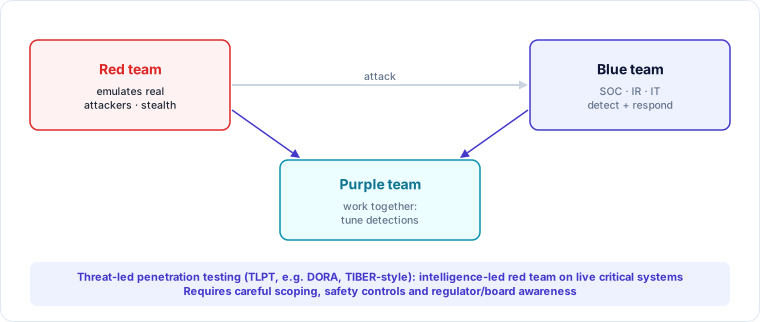
- Red teams emulate real adversaries: they try to reach defined objectives (for example, the ability to initiate payments or delete backups) using the techniques of groups that target the sector. The blue team usually does not know when.
- Blue teams (SOC, IR, IT operations) detect and respond as they normally would.
- Purple teaming puts both together openly: the red team runs a technique, the blue team checks whether it was detected, and detections are tuned on the spot. It is cheaper and faster at improving detection.
Threat-led penetration testing (TLPT) frameworks, such as those used under DORA and the TIBER-style frameworks in Europe, combine threat intelligence on real adversaries with red-team testing of critical functions on live production systems. Key safeguards:
- a control team of very few people inside the organisation who know about the test;
- scoping to critical functions, with "flags" as objectives rather than actual damage;
- legal agreements, rules of engagement and emergency stop procedures;
- board awareness and, where required, regulator involvement;
- careful handling of findings, which are highly sensitive.
Indian regulators require regular VA/PT and, for some entities, red-team exercises. Firms with EU connections may also face DORA TLPT.
3. Testing ransomware recovery end to end
Restore tests prove that backups can be read. A ransomware recovery test proves that the organisation can recover cleanly from a destructive attack. A full test covers:
- Scenario: production and its admin plane assumed compromised; backups reachable from production assumed destroyed.
- Isolation: break-glass access to the vault without production credentials.
- Recovery point selection: using simulated forensic findings (for example, intrusion 12 days ago).
- Clean-room restore of identity, core infrastructure and critical data.
- Validation: malware scanning, integrity checks and reconciliation.
- Bringing a critical service up from the clean environment, with business validation.
- Measuring each step against the runbook estimates (Lesson 5.2).
Run parts of it in parallel with an executive tabletop on the same scenario, so the CMT faces the ransom, disclosure and customer decisions while the technical team shows how long recovery really takes.
4. Sector and national drills
- CERT-In runs cyber security exercises and mock drills with sector regulators and organisations, including financial-sector drills.
- Regulators and sector bodies (for example IDRBT for banks) run or support sector exercises testing coordination across institutions, market infrastructure and regulators.
- Exchanges and depositories run mock trading sessions from DR and other drills that members must join.
Take part when invited. Sector exercises reveal interdependencies that single-firm exercises miss, and they build relationships you will need in a real event.
5. Making cyber exercises safe and useful
- Protect production: red teams use agreed limits; recovery tests run in isolated environments.
- No-fault culture: the goal is to find gaps, not to blame analysts who missed an alert.
- Measure: time to detect, time to escalate, time to contain, time to first regulatory draft, and recovery step times.
- Feed the results back: new detections, playbook changes, scenario library updates and BCMS corrective actions.
Auditor lens
Auditors look for cyber scenarios in the exercise programme, not only in the security team's own plans. They ask: "When did the crisis team last exercise a cyber scenario?", "Has a ransomware recovery been tested end to end, and how long did it take?" and "What changed as a result of the last red-team engagement?"
Case study — Tarang Ledger: clean-room recovery test (month 9)
Scenario: ransomware; intrusion assumed 12 days before detection; production IAM and backups in the production account assumed compromised.
| Step | Estimate | Actual | Note |
|---|---|---|---|
| Break-glass access to vault | 15 min | 40 min | One hardware key holder unreachable; second holder found after 25 min |
| Select recovery point (day −13) | 30 min | 20 min | |
| Identity: new IAM in clean account | 2–3 h | 2 h 50 min | |
| Core infra and logging | 1–2 h | 1 h 30 min | |
| Database restore + validation | 5–6 h | 6 h 45 min | Validation against 13 days of aggregator data took longer |
| Collections API live (test traffic) | 1 h | 50 min | |
| Total | ≈ 11–12 h | ≈ 12 h 55 min | Exceeds the 12 h target |
Actions: a third key holder added and key-holder availability checked weekly; the validation script parallelised and an incremental reconciliation approach designed. The executive tabletop run alongside confirmed that customers' MBCO workaround (bank payment pages) must stay in place for the full recovery period, and that the board's no-ransom policy held under pressure.
Key takeaways
- Match the exercise to the capability: executive and technical tabletops, simulations, cyber ranges, red and purple teams, TLPT, ransomware recovery tests, sector drills.
- Purple teaming improves detection quickly; TLPT tests critical functions on live systems with strict safeguards.
- Test ransomware recovery end to end: vault access without production credentials, recovery point selection, clean room, validation, business service up, timed steps.
- Join CERT-In, regulator and sector drills; measure, stay no-fault and feed results back.
Self-check
- What is the difference between a red team and a purple team exercise?
- Name three safeguards for threat-led penetration testing on live systems.
- Why run an executive tabletop alongside a technical ransomware recovery test?