
The exercise programme and regulatory drill requirements (8.5)
In this lesson you will:
- Explain what ISO 22301 clause 8.5 requires of an exercise programme
- Choose among exercise types from walkthrough to full-scale live exercise
- Build a multi-year programme that meets RBI, SEBI, IRDAI and other drill frequencies
- Include suppliers and customers in the programme
Until a plan has been exercised, it is a hypothesis. Exercises find the wrong phone numbers, the step that takes three times longer than expected and the dependency nobody mapped. They also build the confidence and teamwork that make response work under pressure. Regulators know this, which is why every Indian financial regulator sets drill and testing frequencies.
1. What ISO 22301 requires
Clause 8.5 requires a programme of exercising and testing to validate, over time, the effectiveness of the BC strategies and solutions. Exercises must:
- be consistent with the BC objectives;
- be based on appropriate scenarios that are well planned with clearly defined aims and objectives;
- develop teamwork, competence, confidence and knowledge of those with roles in disruptions;
- taken together over time, validate all BC strategies and solutions;
- minimise the risk of disruption to operations;
- produce formal post-exercise reports with outcomes, recommendations and actions;
- be reviewed in the context of continual improvement;
- be conducted at planned intervals and when there are significant changes.
The organisation must act on the results to implement changes and improvements.
Note the words "over time" and "all". One annual DR drill of the core banking system does not validate the workplace strategy, the supplier workaround or the crisis communication plan. The programme must cover every strategy and solution across a cycle, typically two to three years.
2. Types of exercise
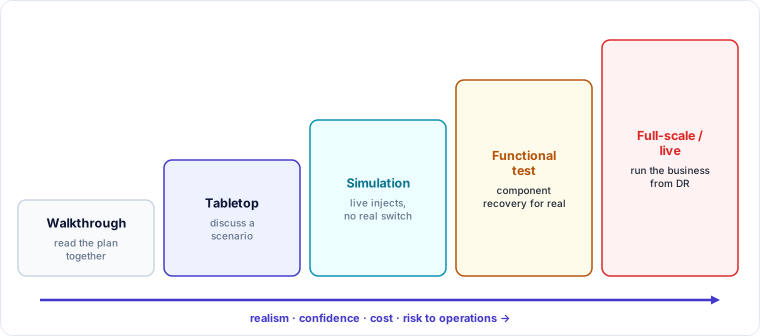
| Type | What happens | Good for |
|---|---|---|
| Walkthrough | Team reads through the plan together, checking steps and contacts | New or changed plans; new team members |
| Tabletop | Facilitated discussion of a scenario with injects; no systems touched | Decision-making, roles, communication, crisis teams |
| Simulation | Realistic, timed injects (calls, emails, mock media) in a simulated environment | Crisis and incident teams under pressure; cyber scenarios |
| Functional test | A component is actually recovered, such as a database restore, a call tree or a work-area recovery site | Technical recovery and specific procedures |
| Full-scale or live | Business actually runs from alternate arrangements, such as live trading from DR | Demonstrating end-to-end capability; regulatory drills |
Build up: walk through a new plan before you tabletop it, and tabletop it before a live test. Live tests carry real risk to operations, so plan them with rollback and safety controls (Lesson 7.3).
3. Regulatory drill frequencies
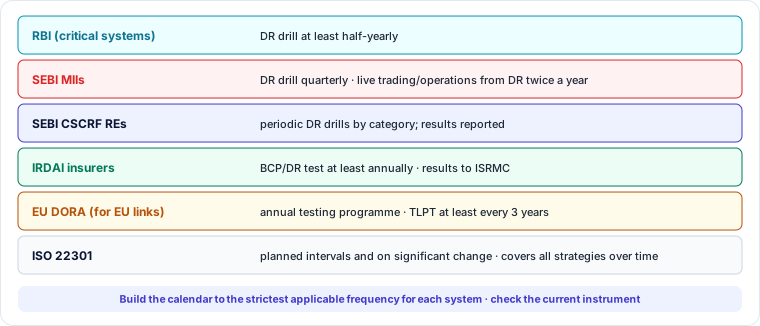
| Source | Requirement (summary) |
|---|---|
| RBI cyber and technology resilience Directions (2026) | DR drills for critical information systems at least half-yearly, with results documented and gaps fixed |
| RBI operational resilience guidance | Scenario testing of critical operations against tolerance under severe but plausible scenarios |
| SEBI MII BCP-DR | DR drills quarterly; live trading or operations from DR at least twice a year; near-site switchover |
| SEBI CSCRF | Periodic DR drills and cyber exercises by RE category; results reviewed by governance bodies |
| IRDAI guidelines (2026) | BCP and DR tested at least annually with realistic scenarios; results to the ISRMC |
| EU DORA (where applicable) | Annual testing programme; threat-led penetration testing at least every three years for significant entities |
| Customer contracts | Often an annual DR test with report shared, or joint participation |
Build the calendar to the strictest applicable requirement for each system, and keep evidence in a form inspectors expect: plan, participants, timings, results, issues and closure.
4. A multi-year programme
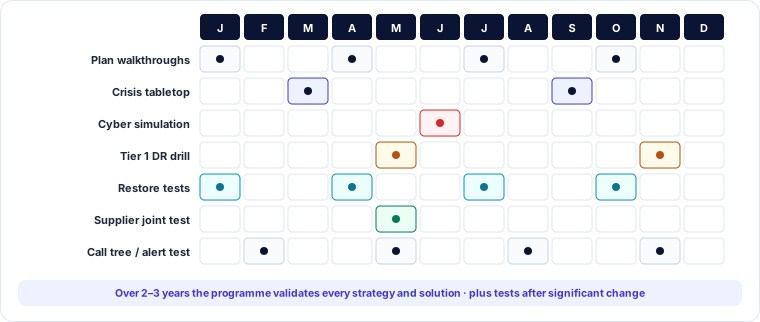
A practical approach:
- List every strategy and solution from the strategy register (Module 4): DR patterns, workarounds, workplace options, supplier alternatives, communication, crisis structure.
- Map regulatory and contractual frequencies to the relevant systems and teams.
- Assign each item an exercise type and frequency, so that all are covered within the cycle and regulatory ones meet their deadlines.
- Vary scenarios across the library (cyber, supplier, facilities, people) and timing (peak days, nights, holidays).
- Include alternates, not just primary role-holders.
- Add tests after significant change, such as a new core system, data-centre migration or major supplier change.
- Avoid peak periods for live tests, unless testing peak behaviour is the point and the risk is controlled.
Suppliers and customers. Critical suppliers should be part of the programme: joint DR tests, participation in tabletops, and review of their own test results. For TSPs, customers increasingly expect to join drills. Plan the logistics and confidentiality early.
Auditor lens
Auditors ask for the programme and check that, over the cycle, every strategy and solution is covered. They pick a regulatory drill and ask for its report and action closure. Common findings: the same DR test repeated every year while workarounds and supplier alternatives are never exercised; alternates never involved; and actions from last year's exercise still open.
Case study — Tarang Ledger: first-year exercise programme
| When | Exercise | Type | Validates | Driver |
|---|---|---|---|---|
| Month 7 | Collections BC plan and DR plan walkthroughs | Walkthrough | Plans, contacts | New plans |
| Month 8 | Crisis tabletop: region outage on the 5th | Tabletop | CMT, IMT, communication | ISO 22301; customer request |
| Month 8 | Exit tabletop with Sahyadri | Tabletop | Customer exit support | RBI outsourcing (customer) |
| Month 9 | Regional failover R-1 with Sahyadri observing | Functional (live, off-peak) | Warm standby, runbook, RTO | Customers; ISO 22301 |
| Month 9 | Clean-room recovery R-2 | Functional | Vault, clean room, data validation | Ransomware scenario S-01 |
| Month 10 | Cyber simulation with MSSP and two customers | Simulation | IR, CCMP, 2-hour customer notice | CSCRF and RBI flow-down |
| Quarterly | Restore tests, call-tree tests | Functional | Backups, notification | ISO 22301; contracts |
| Month 12 | Second regional failover | Functional | Fixes from month 9 | Half-yearly drill expectation from NBFC customers |
Key takeaways
- 8.5 requires a programme that, over time, validates all strategies and solutions, with objectives, scenarios, teamwork, minimal disruption, post-exercise reports, planned intervals and tests after change.
- Exercise types: walkthrough → tabletop → simulation → functional → full-scale/live; build up gradually.
- Regulatory frequencies: RBI half-yearly DR drills; SEBI MII quarterly drills and live from DR twice a year; IRDAI annual; DORA TLPT every three years. Use the strictest that applies.
- Include alternates, suppliers and customers; vary scenarios and timing.
Self-check
- What does "taken together over time" mean for the exercise programme?
- How often must SEBI MIIs run live operations from the DR site?
- Why should alternates take part in exercises?