
Designing exercises: objectives, scenarios and injects
In this lesson you will:
- Write measurable exercise objectives linked to BC objectives and tolerances
- Build realistic scenarios and a master scenario events list (MSEL)
- Assign exercise roles and safety controls
- Facilitate a tabletop that produces useful findings
A badly designed exercise is either a polite discussion that tests nothing or a chaotic event that embarrasses people without teaching them. Good exercise design starts with what you want to learn, builds a believable scenario around it, and sets up the roles and controls to capture what happens.
1. Start with objectives
Every exercise needs a small number (three to six) of objectives, each linked to a BC objective, plan or tolerance and each measurable:
| Weak objective | Measurable objective |
|---|---|
| "Test the crisis plan" | "Crisis team convenes within 30 minutes of activation, using the out-of-band bridge" |
| "Practise communication" | "First customer message issued within 1 hour, using a pre-approved template" |
| "Check DR" | "Collections restored from DR within 2 hours of the decision to invoke; RPO for confirmations verified as zero" |
| "Review reporting" | "Draft CERT-In and customer notices completed within 4 hours of detection, with consistent timelines" |
Objectives determine the scenario, who plays, what is measured and what goes in the report.
2. Scenarios
Take scenarios from the severe-but-plausible library (Lesson 3.4) and make them specific:
- What happens: "Ransomware encrypts Tarang's production environment at 09:00 on the 5th."
- What is unknown at the start, as real incidents begin with uncertainty.
- What still works, for example the bank payment page and SMS gateway 2.
- Time and date, chosen to stress the operation: peak days, Friday evenings, festival weekends.
- Complications that test judgement: a key person unavailable, a media inquiry, a regulator call, a supplier that cannot give an estimate.
Keep scenarios plausible. An exercise in which every system fails at once teaches people that planning is pointless.
3. The master scenario events list
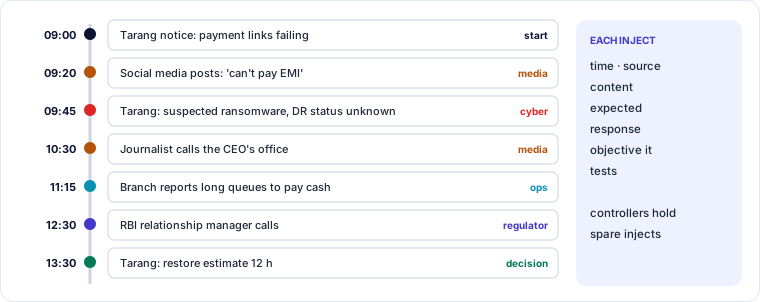
The MSEL is the script. For each inject it lists:
- time (real or simulated);
- source (supplier, customer, journalist, regulator, monitoring tool);
- content: what the players receive (email, call, alert, social media post);
- expected response;
- the objective it tests.
Controllers keep spare injects to speed up a team that is ahead or to add pressure, and can withhold injects if a team is struggling with the core objective. Prepare realistic artefacts: mock emails, alert screenshots, social media posts and a journalist's voicemail. They make a tabletop feel real.
4. Roles and safety
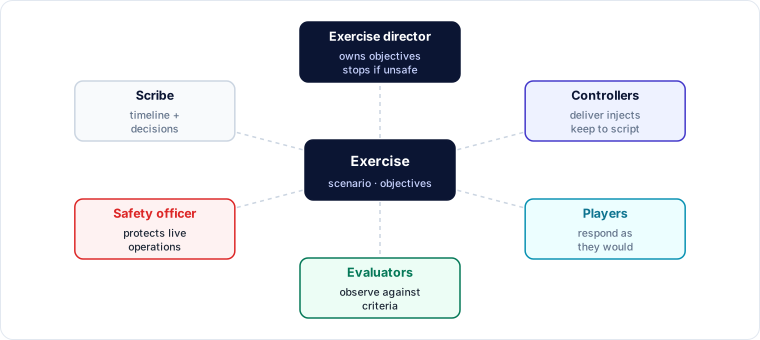
| Role | Responsibility |
|---|---|
| Exercise director | Owns objectives and design; can pause or stop the exercise |
| Controllers / facilitators | Deliver injects, keep to the script, answer player questions in role |
| Players | Respond as they would in reality, using real plans and tools |
| Evaluators / observers | Assess performance against objectives and criteria; note strengths and gaps |
| Safety officer | For live or functional tests, protects real operations; owns the "stop" decision |
| Scribe | Records the timeline, decisions and issues |
Safety controls:
- label all exercise communications clearly ("EXERCISE EXERCISE EXERCISE") so they are never mistaken for real alerts;
- tell those who need to know (help desk, regulators' relationship managers, suppliers) that an exercise is running, while keeping players' surprise where it is part of the design;
- agree a real-incident code word that suspends the exercise immediately;
- for technical tests, define rollback and stop criteria in advance.
5. Facilitating a tabletop
A two- to three-hour tabletop for a crisis team typically runs:
- Briefing (10 min): ground rules (no-fault, act as in reality, use real plans), objectives and roles.
- Scenario phases (three of 30–45 min): each phase starts with injects, then the team discusses and decides. The facilitator asks probing questions: "Who decides?", "What does the plan say?", "What would you tell customers right now?", "What are you assuming?"
- Hot debrief (20–30 min): what went well, what did not, surprises. Capture everything.
- Evaluator notes collected before people leave.
Good facilitation keeps the discussion on decisions and actions, not on how the scenario "would never happen". It also makes sure quieter voices, often the people who would actually do the work, are heard.
Auditor lens
Auditors read exercise plans as well as reports. They expect clear objectives tied to BC objectives, a scenario, a list of participants (including alternates and suppliers where relevant) and evaluation criteria. An exercise plan without objectives, or a report that says only "exercise successful", is weak evidence for clause 8.5.
Case study — Sahyadri and Tarang: joint cyber tabletop design
Objectives:
- Sahyadri's crisis team activates the collections BC plan within 1 hour of Tarang's notice.
- Borrowers due in 3 days receive the bank-payment-link SMS within 90 minutes.
- Tarang's customer notice reaches Sahyadri's 24×7 number within 2 hours of detection.
- Both organisations produce consistent draft regulatory notices within 4 hours.
- Tarang's CISO states clearly whether DR is safe to use, and on what evidence.
Scenario: ransomware at Tarang detected at 09:00 on the 5th; DR status unknown; a social media post goes viral at 09:20.
Roles: director (Anil); controllers from both companies; players (both crisis teams, Tarang IMT); evaluators (Sahyadri's internal audit and an external BCM consultant); scribe from each company.
Safety: all emails marked EXERCISE; RBI and CERT-In not contacted (reporting simulated by sending drafts to the controllers); real-incident code word agreed.
The MSEL in Figure 7.4 drives the three-hour session.
Key takeaways
- Start with three to six measurable objectives linked to BC objectives and tolerances.
- Use specific, plausible scenarios from the library, timed to stress the operation, with realistic complications.
- Drive the exercise with an MSEL: time, source, content, expected response and objective; keep spare injects.
- Define roles: director, controllers, players, evaluators, safety officer, scribe; label communications and agree a stop code word.
- Facilitate tabletops around decisions, with a hot debrief and evaluator notes.
Self-check
- Rewrite "test the DR plan" as a measurable exercise objective.
- What does a master scenario events list record for each inject?
- Why should exercise communications be clearly labelled?