
Supplier, outsourcing and cloud resilience: substitutability and exit
In this lesson you will:
- Turn third-party risk findings into concrete continuity solutions
- Write contract terms that make supplier continuity enforceable
- Design multi-sourcing, workaround and escrow solutions
- Build and test a feasible exit plan for a critical supplier
Lesson 3.5 identified which suppliers are critical and where concentration lies. This lesson covers what to do about it: contract terms, multi-sourcing, workarounds and exit plans that can actually be executed.
1. Strategy options for supplier dependency
| Option | How it helps | Example |
|---|---|---|
| Require supplier resilience | Supplier meets your RTO/RPO itself | Contracted RTO, tested DR, joint drills |
| Multi-source | Two suppliers active; one can absorb the other's load | Two payment aggregators; two telecom carriers on diverse routes |
| Warm alternative | Second supplier contracted and integrated but lightly used | Second SMS gateway with routing switch |
| In-house fallback | Capability you can run yourself in a pinch | Manual reconciliation team; internally hosted payment page |
| Customer-side workaround | Customers use an alternative channel | Borrowers pay via the lender's bank payment page or branches |
| Escrow | Access to source code or data if the supplier fails | Software escrow with release on insolvency; data escrow |
| Planned exit | Move to another provider over time | Exit plan with data export and transition support |
Most critical dependencies need two or more of these.
2. Contract terms that matter
Continuity requirements that are not in the contract are hard to enforce. For critical suppliers, contracts and schedules should cover:
- Service levels and recovery objectives for your service: availability, RTO and RPO, and what counts as a disaster;
- BCP and DR obligations: maintain, test at stated frequencies, share results and remediate findings;
- your participation in tests, or joint testing;
- incident notification: timelines (for example 2 hours for suspected cyber incidents), content and updates;
- audit and access rights for you, your auditors and your regulator. RBI's outsourcing Directions require regulatory access for material outsourcing;
- sub-contracting: notification and approval of material sub-contractors, with continuity obligations flowed down;
- data location, ownership and return in usable formats;
- exit assistance: a transition period, continued service during exit, cooperation with a successor and data deletion;
- termination rights for continuity failures or regulatory direction.
DORA lists similar mandatory terms for EU financial entities, and SEBI's CSCRF expects comparable controls over third parties supporting critical systems.
3. Cloud-specific considerations
Cloud providers are critical suppliers for most institutions, but negotiating power is limited. Practical steps:
- use the provider's financial-services addenda, which often include regulatory access and audit terms;
- rely on independent assurance (SOC 2 reports, ISO 27001 and 22301 certificates, pooled audits) and the provider's published resilience architecture;
- design your own resilience across zones and regions (Lesson 4.3) rather than relying on SLAs;
- keep infrastructure as code and portable data formats to reduce lock-in and support exit;
- assess concentration: how many critical services, and how many of your own suppliers, run on the same provider?
4. Exit plans that work
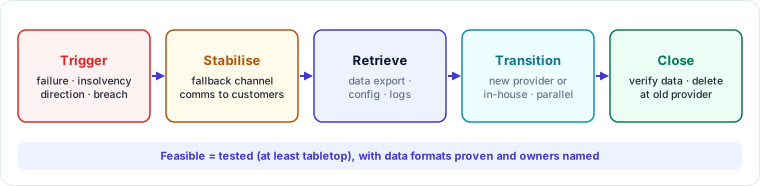
There are two kinds of exit:
- Stressed exit: the supplier fails suddenly (insolvency, cyber attack, regulatory action). Continuity must be maintained immediately, usually through fallbacks and workarounds, while a longer transition is organised.
- Planned exit: a decision to leave for performance, cost or strategy reasons. It runs over months, with parallel running.
An exit plan for each critical supplier contains:
- Triggers and who decides to exit.
- Immediate continuity: which fallback or workaround keeps the MBCO running.
- Data and configuration retrieval: what, in what format, how often you take copies routinely (so you are not dependent on a failed supplier to hand them over).
- Transition options: an alternative provider, in-house or a hybrid; indicative timelines and costs.
- Roles: internal owner, legal, procurement, IT and communications.
- Customer and regulator communication.
- Testing: at minimum a tabletop each year; for the most critical, a technical test such as importing an export into an alternative system.
Regulator lens
RBI's outsourcing Directions and DORA both expect exit strategies to be documented and feasible. Inspectors ask whether the institution has ever tested retrieving its data from the provider, and how long an alternative would take to set up. "We would re-tender" is not an exit plan.
Case study — Sahyadri's exit plan for Tarang
Sahyadri's exit plan for its collections TSP, Tarang:
| Element | Content |
|---|---|
| Triggers | Tarang unavailable > 4 h on a peak day; insolvency; confirmed compromise with unclear containment; regulatory direction; repeated SLA failure |
| Immediate continuity (≤ 4 h) | Switch borrower communications to the bank-hosted payment page (pre-built with Sahyadri's sponsor bank); branches accept cash with manual receipts; NACH continues via the bank directly |
| Data | Nightly export from Tarang of payment ledger and borrower mappings into Sahyadri's data lake (already running); format documented |
| Transition | Option 1: alternative TSP (two shortlisted, indicative 4–6 months); option 2: bank-provided collections module (3–4 months) |
| Roles | Head of collections (owner), CTO, legal, procurement, communications |
| Testing | Tabletop held in month 8; technical test imported one week of Tarang exports into the bank module successfully |
Tarang supports this. Its contracts now include an exit assistance schedule: 6 months of continued service after notice, data exports in documented formats and cooperation with a successor. Its BCMS lists "customer exit support" as a procedure.
Key takeaways
- Combine options: require supplier resilience, multi-source, warm alternatives, in-house or customer-side workarounds, escrow, planned exit.
- Put continuity in contracts: RTO/RPO, testing and joint tests, incident notice, audit and regulator access, sub-contracting, data return and exit assistance.
- For cloud, design your own cross-region resilience, use FS addenda and independent assurance, keep IaC and portable data, and watch concentration.
- Plan for stressed and planned exits; take routine data copies; test exit plans.
Self-check
- What is the difference between a stressed exit and a planned exit?
- Why should data be exported routinely rather than only at exit?
- Name four contract terms that make supplier continuity enforceable.