
Identifying and selecting strategies and solutions (8.3)
In this lesson you will:
- Explain the ISO 22301 requirements for identifying, selecting and implementing continuity strategies and solutions
- Generate options that act before, during and after disruption
- Select solutions using recovery objectives, risk appetite and cost-benefit
- Define the resources each solution needs and make sure it can be activated
The BIA and risk assessment tell you what must recover, how fast and what could stop it. Clause 8.3 asks how you will make that happen. Strategies are the broad approach ("run collections from a warm standby region"). Solutions are the specific arrangements ("replicated database, standby application stack, tested runbook, contract with the cloud provider"). This module covers people, premises, technology, data and suppliers in turn. This lesson sets out the method.
1. What ISO 22301 requires
Identification (8.3.2). Based on the BIA and risk assessment, identify strategies and solutions, considering options for before, during and after disruption. Together they must be able to:
- continue and recover prioritised activities within the identified timeframes and at the agreed capacity;
- protect prioritised activities;
- reduce the likelihood of disruption;
- shorten the period of disruption;
- limit the impact of disruption on products and services;
- provide for the availability of adequate resources.
Selection (8.3.3). Choose based on how well options meet those requirements, the amount and type of risk the organisation may or may not take, and the associated costs and benefits.
Resource requirements (8.3.4). Determine what the selected solutions need: people, information and data, buildings and workplaces with their utilities, facilities, equipment and consumables, ICT, transport and logistics, finance, and partners and suppliers.
Implementation (8.3.5). Implement and maintain the selected solutions so that they can be activated when needed.
2. Options across the timeline
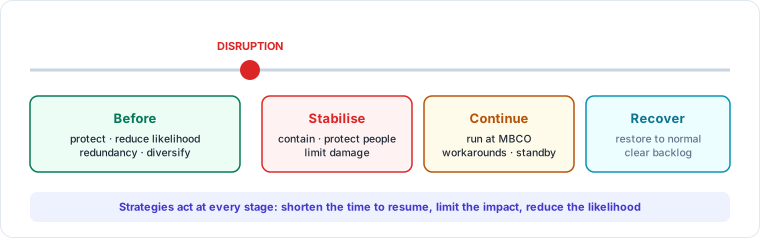
| Stage | Strategy types | BFSI examples |
|---|---|---|
| Before | Protect, reduce likelihood, build redundancy, diversify | Multi-zone deployment; two payment aggregators; cross-trained staff; immutable backups |
| Stabilise | Contain damage, protect people and data | Isolate infected systems; halt affected payment rails; move staff to safety |
| Continue | Run at MBCO using standby capacity or workarounds | Fail over to warm standby; manual processing; bank-hosted payment page |
| Recover | Restore normal service and clear backlog | Rebuild from clean images; reconcile; fail back |
Generic option families used in BCM:
- Diversification: run activities in more than one place or with more than one supplier (split operations, active-active, dual aggregators).
- Replication: maintain a ready copy of resources (standby sites, replicated data, spare devices).
- Standby: contracted or owned capacity activated on need (work-area recovery seats, cloud capacity reservations).
- Post-incident acquisition: buy or rent what is needed after the event (laptops, temporary premises). This is cheap but slow and unreliable in a regional disaster.
- Workarounds: manual or degraded processes that meet the MBCO for a limited time.
- Insurance: finances recovery but does not restore service. It complements other strategies and is never a continuity strategy on its own.
- Accept: do nothing for low-priority activities, with documented approval.
3. Selecting: the recovery-time and cost trade-off
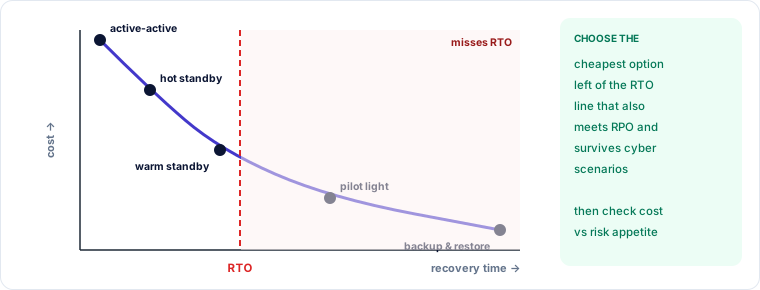
A disciplined selection process:
- Filter by objectives. Discard options that cannot meet the RTO, RPO and MBCO for the activity.
- Test against scenarios. Discard options that fail the severe-but-plausible scenarios from Lesson 3.4. For example, an active-active design that replicates ransomware does not solve S-01 on its own.
- Compare costs and benefits. Include build and run costs, staff time, testing and complexity. Benefits are reduced outage time and avoided harm, regulatory consequences and contract penalties.
- Consider risk appetite. Where no affordable option meets the tolerance, escalate. The board either funds a better option or accepts the residual risk explicitly, with a remediation plan. Regulators expect to see that decision.
- Record the rationale. A short strategy paper per critical operation, approved by the steering group, is strong audit evidence.
Combine strategies. Most critical operations need a mix: a technology strategy (warm standby), a data strategy (immutable backups), a people strategy (remote work), a supplier strategy (dual aggregators) and a workaround for when all else fails.
4. Resource requirements and activation
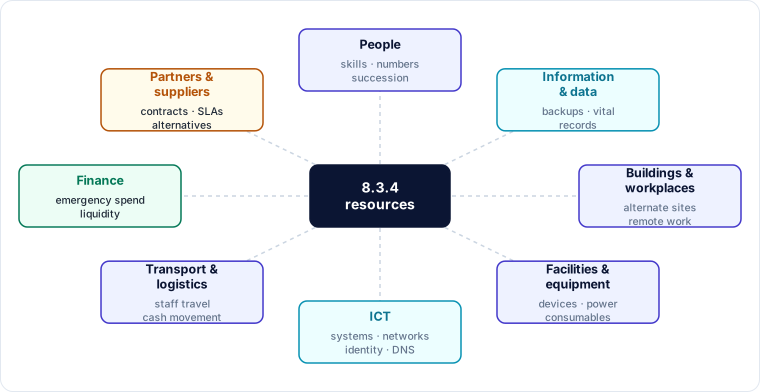
For each solution, list what it needs and confirm it will be there when activated. Commonly forgotten items:
- Finance: pre-approved emergency spending limits, and liquidity to keep paying staff and suppliers.
- Identity: accounts and MFA for staff working from a standby site or new devices.
- Licences: software licensed for the primary site only.
- Transport: moving cash, staff or equipment when roads are flooded.
- Supplier capacity: your work-area recovery provider may sell the same seats to five banks in the same building.
Activation means the solution can be switched on quickly, by people who know how, under pressure. This leads directly to plans (Module 6) and exercises (Module 7). A solution never exercised is an assumption, not a capability.
Auditor lens
Auditors trace from a BIA requirement to the selected strategy, its rationale, its implementation evidence (contracts, configurations, procedures) and its last test. Typical findings: strategies recorded but never implemented ("we will use the Bengaluru office" with no seats or network); or solutions implemented but never shown to meet the RTO.
Case study — Tarang Ledger: strategy options for collections (Tier 1)
Anil and the CTO compare options against the 3-hour RTO, zero RPO for confirmations and scenarios S-01 (ransomware) and S-02 (region loss):
| Option | Meets 3 h RTO? | S-02 region | S-01 ransomware | Annual cost (approx.) | Decision |
|---|---|---|---|---|---|
| A. Backup and restore to another region | No (8–10 h) | Fails RTO | Fails if backups reachable | ₹10 lakh | Rejected |
| B. Warm standby in second region, async replication | Yes (~2 h) | Passes | Fails alone (replicates corruption) | ₹45 lakh | Selected with C |
| C. Immutable vault + clean-room recovery | n/a | n/a | Passes (≤ 12 h with MBCO workaround) | ₹18 lakh | Selected |
| D. Active-active across two regions | Yes (minutes) | Passes | Fails alone | ₹1.2 crore | Rejected: cost and complexity |
| E. Workaround: customers' bank-hosted payment pages | Covers MBCO in ~1 h | Passes | Passes | Low | Selected as fallback with customers |
For ransomware, even B + C cannot meet a 3-hour RTO for full service. The steering group therefore relies on E to keep borrowers able to pay (within Sahyadri's 4-hour tolerance) while the platform is recovered cleanly. The board's audit and risk committee approves the combination and the ₹63 lakh run cost, and records that full platform restoration after ransomware is targeted at 12 hours.
Key takeaways
- 8.3.2 identify options before, during and after disruption that meet timeframes and capacity, protect, reduce likelihood, shorten duration, limit impact and secure resources.
- 8.3.3 select on fit to requirements, risk appetite and cost-benefit; record the rationale.
- Option families: diversify, replicate, standby, acquire later, work around, insure, accept. Insurance alone is not continuity.
- 8.3.4–8.3.5 define resource needs and make solutions activatable; untested solutions are assumptions.
Self-check
- Name four things the selected strategies and solutions must be able to do under clause 8.3.2.
- Why is cyber insurance not by itself a continuity strategy?
- What should happen when no affordable option keeps a critical operation within tolerance?