
People, premises and workplace strategies
In this lesson you will:
- Choose workplace strategies from a recovery profile
- Address key-person and mass-absence risks
- Plan staff safety and welfare as part of continuity
- Apply these strategies to branches, operations centres, dealing rooms and contact centres
Technology gets most of the attention in BFSI resilience, but many disruptions are about people and places: floods that stop staff reaching the office, a fire in an operations centre, a pandemic that halves the workforce, or the one person who knows how to run the month-end process falling ill. This lesson covers the strategies for these.
1. Start from the recovery profile
The recovery profile from Lesson 3.3 says how many people, with what skills and equipment, are needed and when. Use it to choose strategies rather than defaulting to "we have a DR office".
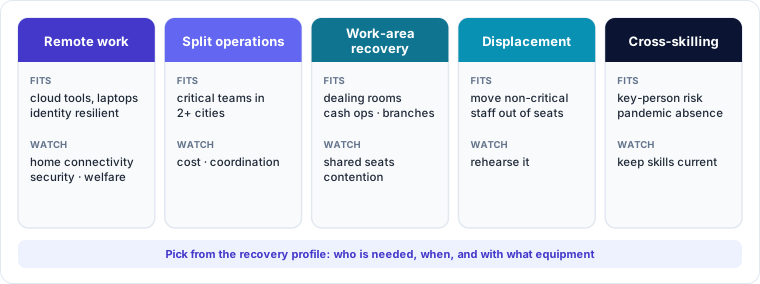
| Strategy | Best for | Watch out for |
|---|---|---|
| Remote working | Most knowledge work; cloud-based operations | Home connectivity during regional events (floods also cut power and networks); security of home working; supervision; ergonomic and welfare issues for long durations |
| Split operations | Critical teams that must survive a city-level event | Cost; duplicated management; keeping both halves equally skilled |
| Work-area recovery (WAR) site | Activities needing special equipment or secure rooms: dealing desks, cash operations, card production, regulated call recording | Shared-seat contracts (oversubscription if many clients invoke at once); travel time to the site; keeping desktops and access current |
| Displacement | Organisations with several sites | Non-critical staff are sent home to free seats for critical teams; rehearse it, since people resist being "non-critical" |
| Reciprocal arrangements | Group companies, partner institutions | Rarely work under pressure; both parties may be hit by the same event |
| Cross-skilling and succession | Key-person risk, mass absence | Skills fade without practice; rotate people through critical tasks |
Remote work is not automatic resilience. It depends on the identity provider, VPN or zero-trust access, collaboration tools, laptops and home broadband. A ransomware attack that takes down identity, or a flood that cuts power across a city, can defeat it. Test remote operation of critical activities at scale, not just a few people at a time.
2. Premises in BFSI
Branches. For banks and NBFCs with branch networks, continuity often means redirecting customers to nearby branches, mobile units or digital channels, and agreeing which services are essential (cash withdrawal, loan repayment). Plans should cover cash logistics, security and local communication.
Operations centres. Centralised processing (payments, reconciliation, loan servicing) concentrates risk. Split operations or tested remote working are common answers. Where processing depends on specific equipment, such as cheque scanners or HSMs, include it in the strategy.
Dealing rooms and market operations. Trading desks need low-latency connectivity, voice recording and specific terminals. MIIs and brokers often maintain dedicated DR trading seats, and SEBI's MII framework expects the DR site to run with its own staff.
Contact centres. These are often outsourced. Check the provider's own continuity plan, multi-site capability and call-routing switch-over, and plan for the volume spike that every outage creates.
Data centres are covered in Lesson 4.3.
3. Key people and mass absence
Key-person risk appears when one person holds unique knowledge or authority: approving payments above a limit, running a legacy batch job, holding the only admin credentials. Strategies:
- document procedures well enough that a trained colleague can follow them;
- name and train deputies for every critical role, including crisis team members;
- review authority delegations, such as payment signatories and regulatory reporting, so that absence does not stop decisions;
- use break-glass credentials with dual control instead of depending on one administrator.
Mass absence (pandemic, strike, regional disaster) needs:
- a list of activities that can stop temporarily, to free capacity;
- cross-skilled pools for critical activities;
- staggered or split shifts to avoid whole teams falling ill together;
- arrangements with contractors or group entities for surge support.
4. Safety and welfare come first
ISO 22301 and every crisis-management standard put life safety first. Continuity strategies must not ask staff to take unsafe risks, such as travelling through floodwater to reach a DR site. Include:
- emergency evacuation and shelter procedures (often under facilities or occupational safety);
- staff accounting: how you confirm everyone is safe after an event;
- welfare support during prolonged disruption: transport, accommodation, food, mental health support, and pay continuity;
- support for families where staff are asked to work extended hours.
People who are worried about their families do not run recovery procedures well.
Auditor lens
Auditors ask: "How many people need to work in the first four hours for this activity, and where will they sit?" Then they check the answer: WAR contract seat numbers, remote-access capacity reports, and the last test where those people actually worked from the alternate arrangement. A strategy that depends on "everyone works from home" without capacity evidence is weak.
Case study — Sahyadri and Tarang: people strategies
Sahyadri (collections operations, Pune):
- Remote working for the 6 people needed in the first 4 hours, with laptops issued and tested. The test showed two staff lacked home broadband backup, so the company issued 4G dongles.
- Displacement at the Nashik regional office: 10 seats can be freed for collections within a day.
- Cross-skilling: a second person trained on NACH file upload, and the bank's sponsor portal access granted to both.
- Branches accept EMI payments in cash with manual receipts as a last-resort workaround, with daily reconciliation.
Tarang:
- Split on-call: cloud operations engineers in Pune and Bengaluru, so a city-level event does not remove the whole team.
- Key-person: two engineers hold all database recovery knowledge; runbooks are written and three more engineers are trained in quarterly restore tests.
- Welfare: a crisis travel and accommodation budget pre-approved at ₹5 lakh, so the incident manager can book hotels without waiting for approval.
Key takeaways
- Choose workplace strategies from the recovery profile: remote work, split operations, work-area recovery, displacement, cross-skilling.
- Remote work depends on identity, connectivity and devices, which regional events and cyber attacks can defeat; test it at scale.
- Treat branches, operations centres, dealing rooms and contact centres on their own terms.
- Manage key-person and mass-absence risk with deputies, documentation, delegations and cross-skilled pools.
- Life safety and welfare come first.
Self-check
- Why might remote working fail during a city-wide flood?
- What is the main risk in a shared-seat work-area recovery contract?
- Name three ways to reduce key-person risk.