
Recovery, business continuity and post-incident review
In this lesson you will:
- Choose recovery strategies including trusted rollback, clean checkpoint restoration and vector-store recovery
- Design AI circuit breakers and kill switches
- Build AI business continuity and disaster recovery plans with dependency mapping
- Run post-incident reviews and update TTP registers
- Securely decommission and dispose of AI systems
Recovery returns the AI system to trusted operation. Continuity planning makes sure the business can keep going when the AI can't. And every incident should leave the organisation stronger.
1. Recovery strategies
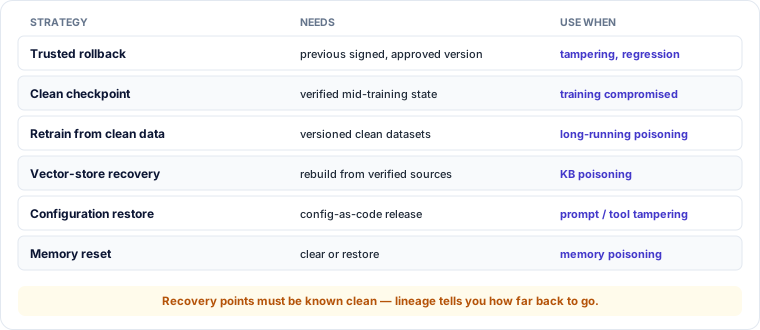
| Strategy | Use when | Requirements |
|---|---|---|
| Trusted model rollback | Current model is tampered with, poisoned or regressed | Previous signed, approved version available and still valid |
| Clean checkpoint restoration | Training was compromised partway | Versioned checkpoints with hashes and known-clean data lineage |
| Retrain from clean data | Poisoning affected many versions | Clean, versioned datasets and reproducible pipelines |
| Vector-store recovery | Knowledge base poisoned or corrupted | Rebuild from verified source documents, or restore a verified index snapshot |
| Configuration restore | Prompts, tools or guardrails tampered with | Configuration as code; known-good release |
| Memory reset | Agent memory poisoned | Clear or restore memory; review what it influenced |
Recovery points must be known clean: if poisoning began three months ago, last week's backup is not a recovery point. Lineage tells you how far back to go.
2. Circuit breakers and kill switches
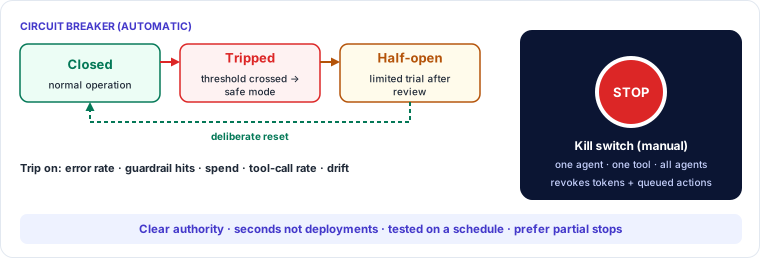
- Circuit breakers — automatic controls that stop or degrade an AI function when metrics cross thresholds: error rates, guardrail hits, spend, unusual tool-call rates, drift. They "trip" to a safe state (fallback, human queue) and need deliberate reset.
- Kill switches — manual controls that immediately halt an AI system, an agent, a tool, or all agents. Requirements: clear authority (who may pull it), speed (seconds, not a deployment), completeness (revoke tokens, stop queued actions), and regular testing.
- Design for partial stops: disabling one tool or one capability is often better than stopping everything.
3. Business continuity and disaster recovery
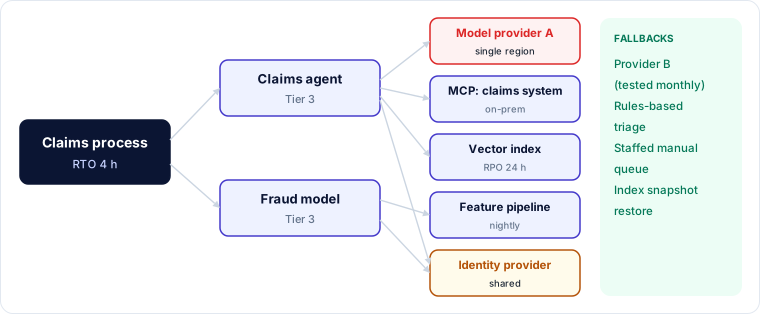
- Critical AI dependency mapping — for each critical business process, map the AI systems it relies on and their dependencies: model providers, regions, GPU capacity, vector stores, data pipelines, identity providers, MCP servers and partner agents.
- Business impact analysis — how long can the process run without the AI? What is the manual fallback? Set RTO (recovery time objective) and RPO (recovery point objective) for models, indexes and configurations.
- Fallbacks — alternative providers or self-hosted models; cached or rules-based modes; staffed human processes. Test them.
- Skills and staffing — if an AI system replaced manual work, can people still do it during an outage?
- Backups — models, adapters, configurations, prompts, indexes and evaluation sets, with integrity protection and tested restoration.
4. Post-incident review
Run a blameless post-incident review (PIR) for every significant AI incident:
- Timeline and kill chain; what detected it and how fast.
- Root causes and contributing factors (technical, process, people).
- What worked and what didn't in detection, containment and communication.
- Actions with owners and dates: control fixes, new detections, playbook updates, training.
- Regression tests added for the incident payloads.
Update the TTP register (tactics, techniques and procedures) — the organisation's record of attacker behaviour seen, mapped to MITRE ATLAS — and feed it into threat models, red-team scenarios and detection rules. Share anonymised lessons with peers and industry groups where appropriate.
5. Secure decommissioning and disposal
When an AI system or model is retired — or must be terminated after an incident:
- Model termination — remove from serving; revoke it in the registry so it can't be reloaded; delete or archive weights according to policy, with key destruction (crypto-shredding) where appropriate.
- Data and index disposal — delete training data no longer needed, vector indexes, caches and logs per retention schedules; sanitise media (Module 4).
- Machine unlearning — where a model must continue but specific data must be removed, retrain without it or apply unlearning techniques, and document the evidence.
- Identity and access — revoke agent identities, API keys, OAuth grants and connector credentials.
- Dependants — notify systems and teams that relied on the model; update the inventory and AIBOMs.
- Records — keep the decommissioning record, disposal evidence and documentation required for audit or regulation.
Worked example — recovering from a poisoned knowledge base
A legal-research assistant's index was poisoned over six weeks with documents containing false case citations.
| Step | Action |
|---|---|
| Find the clean point | Lineage shows first malicious upload 41 days ago; the last verified snapshot is 45 days old |
| Recover | Restore the 45-day snapshot; re-ingest legitimate documents added since, after author verification and content review |
| Circuit breaker | New rule: if a document added in the last 7 days appears in > 10% of answers, it is quarantined automatically |
| Continuity | During the 3-day rebuild, the assistant ran in "citation-only" mode returning source links without generated summaries |
| PIR | Root cause: any registered user could upload; no author verification. Fix: upload restricted to verified contributors; content checks for instruction-like text |
| TTP register | Added "slow knowledge-base poisoning via contributor uploads", mapped to ATLAS poisoning techniques |
🔐 Security lens
Test your kill switch the way you test fire alarms — on a schedule, with the people who would pull it. A kill switch that needs a developer and a deployment is a feature request, not a control.
Key takeaways
- Recover to known-clean points: trusted rollback, clean checkpoints, retraining, index rebuilds, configuration and memory restores — guided by lineage.
- Circuit breakers trip automatically on thresholds; kill switches are manual, fast, complete and tested; prefer partial stops.
- Map critical AI dependencies, set RTO/RPO, build and test fallbacks, and keep human skills alive.
- Run blameless PIRs, add regression tests and update the TTP register.
- Decommission securely: revoke and remove models, dispose of data and indexes, unlearn where needed, revoke identities and keep records.
Self-check
- Why might last week's backup not be a valid recovery point after a poisoning incident?
- What makes a kill switch effective?
- What should a critical AI dependency map include beyond the model itself?