Ready reckoner
Readiness
- PoLP and SoD in AI ops; need-to-know for telemetry.
- Roles: system owner (rollback/suspend decisions) · data owner (quarantine) · MLOps (executes) · SOC · AI security · data science · privacy/legal · comms.
- Baselines from release criteria: quality · safety · reject rate · human-override rate · latency · cost. Alert both directions.
- Playbooks (decisions) vs runbooks (steps). AI playbooks: injection/exfil · poisoning · tampering/theft · agent misuse · harmful outputs · provider incident · denial of wallet. Tabletop them.
- Config as code; gate automated/provider updates; detect configuration drift.
Telemetry
Collect: prompts · outputs · retrievals · index changes · tool calls (with on-behalf-of IDs) · model API traffic · guardrail events · platform & identity logs. Best points: AI gateway + agent harness. Correlate with identity, endpoint, network, TI; SOAR for first response. Integrity: append-only, signed, time-synced; versions in every event. Tiers: metadata (broad) · masked content (investigations) · full content (break-glass). Consistent tokenisation.
Detection
| Point | Signals |
|---|---|
| Inputs | Injection hits, encoded payloads, rephrasing refused asks |
| Retrieval | Out-of-domain or sensitive spikes; new docs over-retrieved |
| Outputs | PII/secrets, external URLs, prompt leakage |
| Agency | Unregistered principals, first-time destructive tools, threshold probing |
| Resources | Token spikes, long sessions, loop limits |
| Integrity | Hash ≠ registry; unscheduled training; config drift |
AI for SOC: UEBA (incl. agents), triage, hunting, response assist — SOC AI is injectable.
Posture
Register: CVEs · model weaknesses (jailbreaks) · exposures · supply-chain advisories → linked to inventory & AIBOM. Prioritise by exposure, data, agency, exploitability, consequence, existing controls. Patch: dependencies, models, prompts/guardrails, OSS, platform — via gates. Legacy: wrap (gateway, filters, limits) · restrict (internal, no tools) · human review · tighter monitoring · time-bound exception. AI-SPM + metrics: inventory coverage, signed-model %, MTTR, scope reviews, red-team coverage, shadow AI found.
Respond and investigate
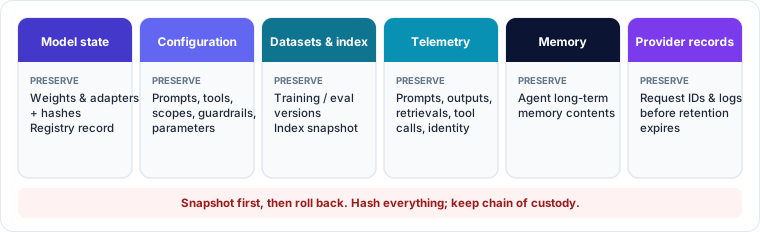
Taxonomy: injection · jailbreak · poisoning · theft/extraction · tampering · disclosure · agent misuse · availability · supply chain · harmful outcomes. Escalate: IC · owner · MLOps · data science · privacy/legal · compliance (CERT-In 6 h, DPDP breach notice, EU AI Act serious incidents) · comms. Contain: rollback · disable tool/scope · suspend agent + revoke tokens · isolate endpoint · throttle · restrict retrieval · suspend pipeline · fallback · rotate creds. Snapshot first: weights + hashes, config, datasets & index, telemetry, memory, provider records. Investigate: kill chain · RCA (conditions, not trigger) · attribution with confidence · replay with pinned versions. Eradicate: sanitise data, retrain/roll back, patch, rotate → safety regression → staged reintroduction.
Recover
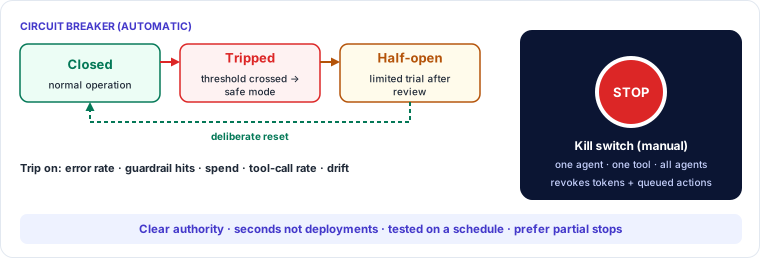
Strategies: trusted rollback · clean checkpoint · retrain from clean data · vector-store rebuild · config restore · memory reset. Known-clean points only. Circuit breakers (automatic, thresholds) vs kill switches (manual, seconds, revoke tokens & queues, tested). Prefer partial stops. BC/DR: dependency map (providers, regions, GPUs, pipelines, IdP, MCP, partners), RTO/RPO, tested fallbacks, human skills, integrity-protected backups. PIR: blameless, actions, regression tests, TTP register (ATLAS). Decommission: registry revocation, weights/data/index disposal (crypto-shred), unlearning where needed, revoke identities, update inventory/AIBOM, keep records.
Exam-day reflexes
- "Reject rate fell to zero" → investigate bypass.
- "Agent stopped but still acting" → revoke tokens.
- "Roll back the tampered model now" → preserve evidence first.
- "Tool trusted the agent, not the user" → root cause.
- "Kill switch needs a deployment" → not a control.
Visual summary