Ready reckoner
Roles and residency
| Role | Remember |
|---|---|
| Owner | Approves each new use (e.g. training) |
| Steward | Quality, metadata, lineage |
| Custodian | Runs storage, access, encryption |
| Controller / Data Fiduciary | Decides purposes & means; primary legal duty |
| Processor | Acts on instructions (e.g. model API provider) |
Hidden cross-border flows: prompts to APIs · provider logs · spare-region training · global vector DBs · shipped weights.
Classification and lineage
- Derived artefacts (embeddings, weights, adapters, caches) inherit source classification.
- Tags make policy machine-enforceable (retrieval filters, DLP).
- Provenance = origin; lineage = transformations and flows. Label synthetic data.
Lifecycle and custody
Collection → validation (poisoning screens) → transformation → storage & use → retention → archiving → deletion (all copies). Custody: immutable versions · hashes at hand-off · signed attestations · access logs · separation of duties. Logs of prompts/outputs are highly sensitive — classify, restrict, short retention.
Privacy techniques
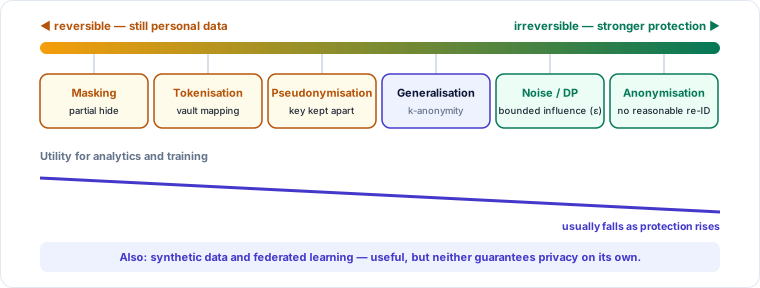
| Technique | Reversible? | Still personal data? |
|---|---|---|
| Masking | Usually no | Often, with context |
| Tokenisation | Yes (vault) | Yes |
| Pseudonymisation | Yes (key) | Yes (GDPR) |
| Generalisation (k-anon) | No | Depends |
| Differential privacy | No | Bounded risk (ε smaller = stronger) |
| Anonymisation | No | No — if truly achieved (hard) |
DP-SGD limits memorisation. Federated learning: data stays local, updates can leak. Quasi-identifiers re-identify. Regs: GDPR · DPDP · HIPAA (PHI, BAAs) · PCI DSS (keep card data out of prompts, logs, training).
AI-specific privacy and IP
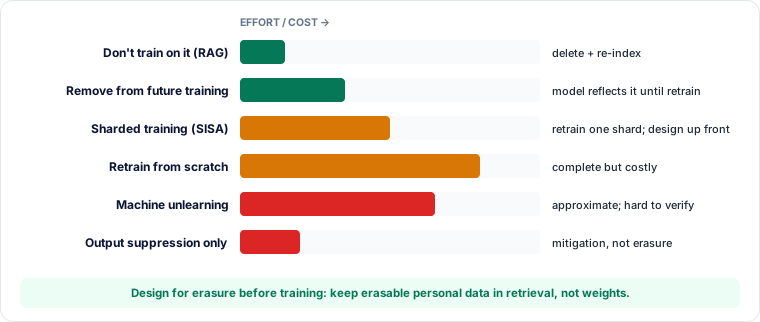
- Erasure options: RAG (easiest) · drop from next retrain · SISA sharding (design up front) · full retrain · unlearning (approximate) · output suppression (mitigation only).
- Regulatory contamination: regulated data pulls pipelines and models into scope → intake filtering, segregation, tags, contracts.
- Export-controlled data via retrieval = possible unlicensed access.
- IP: unsettled copyright law; licence register; honour opt-outs; output similarity checks; vendor indemnity.
- Consent: specific, granular, withdrawable. Public ≠ free to use.
Training-data security
| Attack | Goal |
|---|---|
| Availability poisoning | Degrade everything |
| Targeted poisoning | Specific wrong output |
| Backdoor | Hidden trigger behaviour |
| Label tampering | Corrupt ground truth |
| Malicious dataset | Poison or run code |
| Extraction | Steal learned data |
Small corpora (fine-tune, RAG) are most exposed. Controls: vetted sources · validation · label QA · immutable versioning · influence analysis · isolated golden test sets · trigger search. Synthetic data: bias, missing tails, leakage, collapse.
Protection controls
- DSPM finds shadow training data and exposed AI stores.
- AI gateway: input + output DLP and semantic filters, policy by identity and tags.
- Encrypt at rest · in transit · in use (TEE) — plus access control.
- Keys: KMS/HSM · BYOK / HYOK · vault for secrets · short-lived · rotate · revoke · destroy. No secrets in prompts.
- Purpose-based access, governed agent data catalogues, JIT access.
- Sanitise: crypto-erase (cloud), purge (secure erase), destroy (micro-shred); NIST SP 800-88.
Exam-day reflexes
- "Erasure for a fine-tuned model" → design with RAG; retrain; unlearning is approximate.
- "Pseudonymised = anonymous?" → No.
- "Card numbers in transcripts used for fine-tuning" → PCI scope contamination.
- "API key in system prompt" → rotate, vault, inject in harness.
- "Cloud storage sanitisation" → cryptographic erasure.
Visual summary