
Data ownership, sovereignty, classification and lineage
In this lesson you will:
- Distinguish data owner, steward, custodian, controller and processor roles for AI data
- Apply data sovereignty and cross-border residency requirements to AI pipelines
- Classify and tag AI data and perform sensitive-data impact assessments
- Record provenance and lineage, including real versus synthetic data
AI systems are built from data and keep consuming it in operation — prompts, retrieved documents, tool results, feedback. Governing that data starts with four questions: who owns it, where may it live, how sensitive is it, and where did it come from?
1. Data roles
| Role | Responsibility in an AI context |
|---|---|
| Information / data owner | Business executive accountable for a dataset; approves its use for training or retrieval; sets classification |
| Data steward | Maintains quality, metadata, definitions and lineage day to day |
| Data custodian | Operates the technical controls — storage, access, backup, encryption (often IT or platform teams) |
| Controller (GDPR) / Data Fiduciary (DPDP) | Decides the purposes and means of processing personal data; bears primary legal responsibility |
| Processor | Processes personal data on the controller's behalf — e.g. a model API provider processing your prompts |
| Model owner | Accountable for a model built from the data, including how it may be reused |
A frequent gap: the data owner approved data for one purpose (say, fraud analytics) and a data-science team later uses it to train a customer chatbot. A new purpose needs a new approval — and, for personal data, a lawful basis.
2. Sovereignty and residency
Data residency is where data is physically stored and processed. Data sovereignty is the principle that data is subject to the laws of the country where it resides — and sometimes of the provider's home country as well.
AI pipelines move data across borders in ways that are easy to miss:
- Prompts sent to a model API hosted in another region.
- Logs and abuse-monitoring copies kept by the provider in a third country.
- Fine-tuning jobs run in whichever region has spare GPU capacity.
- Embeddings stored in a global vector database.
- Model weights that encode personal data, shipped to another jurisdiction.
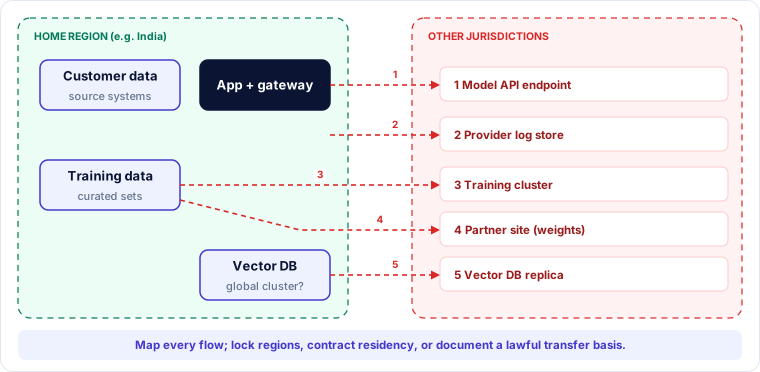
Controls: regional endpoints, contractual residency commitments, region-locked training jobs, data-flow mapping in the AI inventory, and transfer assessments where law requires them. Sector rules (for example in banking or government) may require certain data to stay in-country entirely.
3. Classification, tagging and sensitive-data impact assessment
Use your existing classification scheme — but extend it to AI artefacts:
- Training, validation and test datasets carry the classification of their most sensitive content.
- Derived artefacts — embeddings, fine-tuned weights, adapters, cached responses — can encode the source data and should inherit its classification unless shown otherwise.
- Prompts and outputs can contain anything users type; classify the logs accordingly.
Tagging makes classification machine-enforceable: tags on datasets, documents and vector-store chunks let retrieval filters, DLP and access policies act automatically.
A sensitive-data impact assessment asks, before data is used for AI: What sensitive categories are present? Is the use compatible with the original purpose? What could the model memorise or reveal? Which controls (minimisation, de-identification, access restrictions) reduce the risk?
4. Provenance, lineage and sourcing
- Provenance — where data originated: collected from customers, licensed from a vendor, scraped from the web, generated synthetically.
- Lineage — how it was transformed and where it flowed: cleaning, labelling, joining, splitting, into which model versions.
- Real vs synthetic — synthetic data must be labelled as such, because it behaves differently (it can lack rare cases and can amplify the generating model's bias) and because of model-collapse risk.
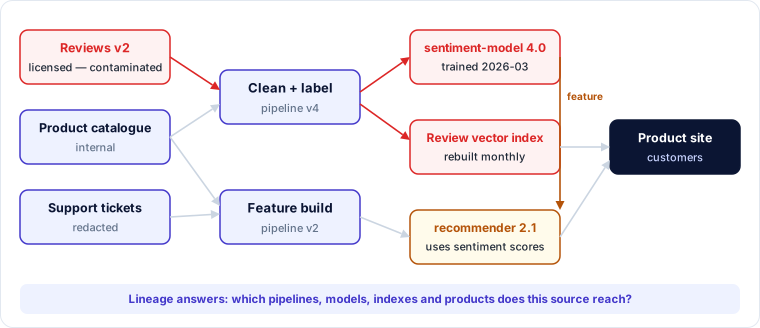
Worked example — tracing a contaminated source
A retailer learns that a third-party product-review dataset it licensed contained scraped personal data collected without consent.
| Question | Answer from lineage records |
|---|---|
| Which pipelines used the dataset? | Review-sentiment pipeline v3 and v4 |
| Which models were trained on it? | sentiment-model 3.2 and 4.0; the recommendation model used sentiment scores as a feature |
| Which embeddings or caches include it? | Product-review vector index (rebuilt monthly) |
| What should happen? | Remove the dataset; rebuild the index; retrain sentiment 4.0 on clean data; assess whether the recommendation model needs retraining; notify the data owner and privacy office |
Without lineage, the safest option would have been to retire every model trained in the last two years.
🔐 Security lens
Treat embeddings, fine-tuned weights and response caches as copies of their source data for classification and access-control purposes. Attackers will.
Key takeaways
- Owners approve uses; stewards keep metadata and lineage; custodians run controls; controllers and processors carry legal duties.
- AI pipelines create hidden cross-border flows — map them and lock regions where required.
- Derived artefacts inherit the classification of their source data; tags make classification enforceable.
- Provenance and lineage, including real vs synthetic labelling, let you respond precisely when a source goes bad.
Self-check
- A model API provider processes your prompts under contract. What is its GDPR role?
- Name three places personal data can cross borders in an AI pipeline.
- Why should a fine-tuned adapter inherit the classification of its training data?