Ready reckoner
Identify
Taxonomy: security · privacy · performance & safety · fairness & rights · legal & compliance · operational & strategic.
Scenario = threat source → vector → AI asset → event → impact. Vague risks can't be rated.
Assess
- Heat map (1–5 × 1–5) to communicate; include harm to people in impact scales and exposure + autonomy in likelihood.
- Quantify the top risks: annualised loss ≈ LEF × LM, as ranges. LEF = attempts × probability of success (use red-team results).
- Record in the enterprise risk register, owned by the business, linked to inventory IDs, mapped to NIST AI RMF / EU AI Act / OWASP / ATLAS.
Impact assessment and tiering
- AIIA sections: system · decisions · algorithmic risk · autonomy & actions · data · security · stakeholders · mitigations. Guidance: ISO/IEC 42005. EU deployers: fundamental rights impact assessment for some high-risk uses.
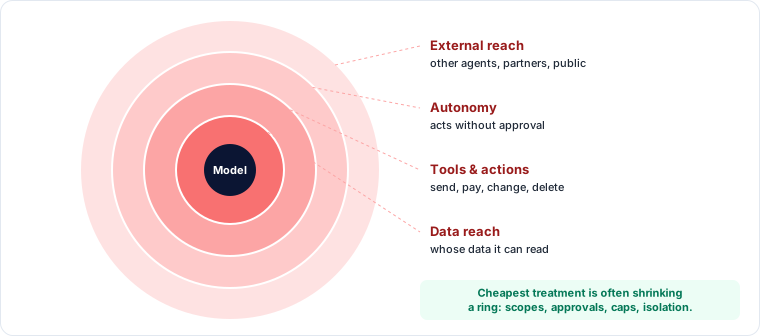
- Blast radius = data reach + action reach + autonomy + scale + propagation − reversibility.
- Tier by human impact × complexity/autonomy. Legal classification sets the floor.
| Tier | Typical | Controls |
|---|---|---|
| 1 Low | Internal, human reviews all | Register, acceptable use |
| 2 Medium | Customer-facing, limited actions | + security review, testing, monitoring, disclosure |
| 3 High | Decisions about people, autonomy, regulated | + AIIA, bias tests, red team, HITL, committee |
Treat
| Option | AI example | Watch |
|---|---|---|
| Mitigate | Permission-aware retrieval, HITL | Defence in depth |
| Transfer | Indemnity, insurance | Moves cost, not accountability |
| Avoid | Rules engine instead of LLM | Redesign the activity |
| Accept | Residual hallucination in drafting tool | Owner, rationale, expiry |
Layers: governance & people · agent & tools · application · prompt & context · model · data · infrastructure. Control types: preventive, detective, corrective, deterrent, compensating (legacy models).
Reassessment triggers: model change · drift · vulnerability · new use/users · new data/tools · incident (here or peers) · regulation · time. KRIs: blocked-injection rate, guardrail hits, override rate, drift, unregistered AI found, patch time, cost per request.
Third parties
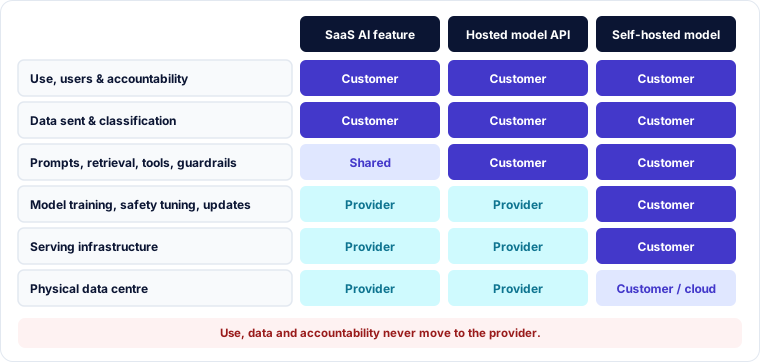
| Layer | SaaS AI | Model API | Self-hosted |
|---|---|---|---|
| Use, data, accountability | Customer | Customer | Customer |
| Prompts, retrieval, tools, guardrails | Shared | Customer | Customer |
| Model training & updates | Provider | Provider | Customer |
| Infra & data centre | Provider | Provider | Customer / cloud |
- AI due diligence: training on your data? retention, sub-processors, model change notice, evaluations, injection defences, tenant isolation, logs.
- Reports: check scope, period (Type II), exceptions, CUECs. Certificates ≠ safe model.
- Contract: data use · security SLAs · incident notification (incl. model failures) · change notice / pinning · audit · sub-processors · IP indemnity · regulatory cooperation · exit.
Supply chain
- Stages: data → pre-training → distribution → adaptation → software → app (+ hardware/hosting).
- AIBOM = models, datasets, software, hardware, lineage, licences, attestations (SPDX / CycloneDX).
- Verify: approved sources, verified publisher, hash / signature, safe formats (no code on load), own evals, internal registry.
- TEE + remote attestation: data and weights protected in use; keys released only to attested code. Limits: overhead, side channels, hardware trust.
Exam-day reflexes
- "Cheapest effective treatment for an over-powered agent" → shrink blast radius.
- "Vendor indemnifies discrimination" → you are still accountable.
- "Silent model update" → reassessment trigger; contract for change notice.
- "Which systems use the backdoored model?" → AIBOM + inventory.
- "Pickle file from unknown publisher" → code execution risk; block.
Visual summary