
5.4 AI vulnerability and asset posture management
In this lesson you will:
- Record AI weaknesses, including ones with no CVE and no patch, and close them only when verified.
- Rank AI vulnerabilities by real risk rather than by score alone.
- Patch AI pipelines without breaking the behavior you tested.
- Keep a model you cannot fix safe enough to run until it is retired.
- Choose posture metrics that tell leaders something true.
Opening case: "fixed"
Meridian's quarterly AI vulnerability review lists three items:
- CVE in the inference server used by the internal document summarizer (CVSS 9.8, in CISA's Known Exploited Vulnerabilities catalog). The summarizer is reachable only from the corporate network.
- A jailbreak that makes the public chatbot write insulting replies. The vendor's guardrail update has been applied, and the engineer marked it "fixed" after trying the jailbreak once and getting a refusal.
- A prompt injection through uploaded PDFs that makes the Collections agent offer settlement discounts it is not authorized to offer. No CVE exists. The agent can write to customer accounts.
There is also a fourth problem nobody has listed: the 2021 credit-limit model runs on a vendor platform that is out of support, and retraining is scheduled for next year.
By the end of this section you will be able to rank these items, say whether item 2 is really fixed, and decide what to do about the 2021 model.
Registers from discovery to verified closure
AI vulnerabilities come in two kinds:
- Conventional vulnerabilities live in the software around the model: inference servers, ML libraries, notebooks, vector databases, container images. They have CVE identifiers and patches.
- AI-specific weaknesses live in the model and its configuration: susceptibility to a jailbreak technique, a guardrail bypass, a system prompt that leaks, a retrieval path that overshares, an agent with excessive permissions. Many have no CVE and no patch; the fix may be a configuration change, a new guardrail, retraining or a design change.
Track both in two registers, shown in Figure 5.7:
- a vulnerability register of specific weaknesses to fix;
- an exposure register of where AI assets are reachable or over-permissioned.
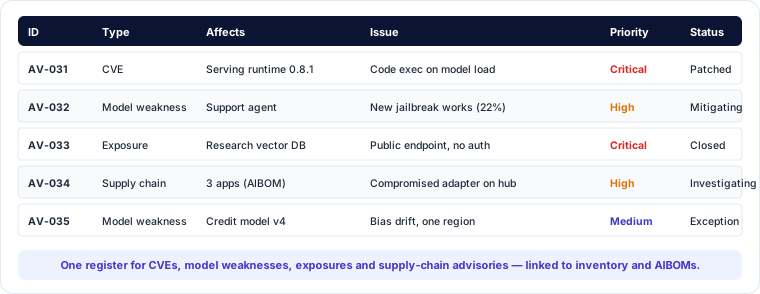
Each entry moves through a defined lifecycle: discovered → triaged → assigned → remediated → verified closed [1][2].
Worked example: is item 2 really fixed?
Verification matters more for AI than for conventional software because of non-determinism (section 1.3). A jailbreak that "no longer works" on one attempt may still work one time in twenty.
The engineer re-ran the jailbreak 200 times with the original wording and 10 variants (paraphrased, translated, split over two turns):
| Test | Attempts | Successes | Rate |
|---|---|---|---|
| Original wording | 20 | 1 | 5% |
| Paraphrases (5) | 100 | 4 | 4% |
| Translations (3) | 60 | 7 | 12% |
| Two-turn split (2) | 20 | 3 | 15% |
The guardrail update reduced the rate, but item 2 is not closed. It goes back to "remediated, failed verification", with the translation and multi-turn variants added to the regression suite. The closure criterion should be written down in advance, for example "below 0.5% across the standard variant set at n ≥ 200".
Prioritizing AI vulnerabilities
Severity scores such as CVSS help for conventional flaws, together with exploitation evidence such as CISA's Known Exploited Vulnerabilities (KEV) catalog and the EPSS exploit-prediction score [20]. For AI weaknesses, and for conventional ones in AI systems, prioritize on context:
| Factor | Question |
|---|---|
| Exposure | Internet-facing to anonymous users, or internal to a small trusted group? |
| Exploitation | Is there a public technique or evidence of active use? |
| Data sensitivity | What data can the affected system reach or reveal? |
| Privileges | Can the system act (agents with tools) or only answer? |
| Existing controls | Do other layers already block the impact? |
| Consequence | What is the worst realistic outcome for people and the business? |
Worked example: ranking the opening items
| Item | Exposure | Exploitation | Privileges | Consequence | Rank |
|---|---|---|---|---|---|
| 3 · PDF injection, Collections agent | Customers upload PDFs | Known technique | Writes to accounts | Unauthorized financial commitments, fair-treatment breaches | 1 |
| 1 · Inference server CVE | Internal only | KEV-listed | Server compromise → lateral movement | Breach of internal documents | 2 (patch within the KEV deadline) |
| 2 · Chatbot jailbreak | Public | Known | Answers only | Reputational | 3 |
Item 3 has no CVE and no score, yet ranks first, because an attacker-controlled input reaches an agent that can change customer accounts. Item 1 has the highest score and active exploitation, so it is patched quickly too; being internal-only lowers but does not remove the urgency. Item 2 matters, but its worst outcome is embarrassment.
Exam lens. A question that contrasts a high CVSS score with an AI weakness that has no score usually wants you to prioritize by context: exposure, privileges and consequence. "An agent with tools that can be manipulated by untrusted input" almost always outranks "a model that says something rude."
Patch management for AI pipelines
Patching must be inventory-driven: you can only patch what you know you run. The AIBOM (section 2.5) and AI-SPM tooling (section 3.4) show which systems use which libraries, models and base images. Then:
- patch dependencies and open-source components through the normal pipeline, with pinned and verified versions;
- treat model updates as changes, with evaluation and staged rollout, because a "patched" model may behave differently;
- update guardrail models and rules as new attack techniques emerge, with regression testing;
- rebuild rather than patch in place for container images, so production matches what was tested.
Legacy models
Some models cannot easily be fixed: the vendor has stopped supporting them, retraining is too expensive, or the system is about to be replaced. Manage them with the layers shown in Figure 5.8.
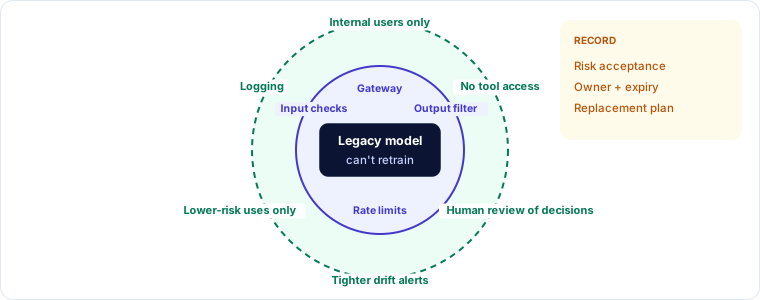
- Compensating controls: stricter input and output filtering, reduced permissions, network isolation, additional human review.
- Usage restrictions: remove high-risk use cases; narrow the user group.
- Time-limited exceptions: formally approved by the risk owner, recorded with an expiry date and a retirement plan.
For the 2021 credit-limit model: isolate the vendor platform from other systems, route all limit increases above a threshold to human review, add monitoring of approval rates by segment (section 1.3), and record a risk-owner exception expiring at the planned retraining date. If the date slips, the exception expires and must be re-approved, not silently extended.
Continuous review and posture metrics
Run continuous AI security reviews: automated scans of AI assets and configurations, periodic red-team testing (Module 6), and reassessment when triggers fire (section 2.3).
Report posture metrics that mean something to governance:
| Metric | Why it matters |
|---|---|
| Share of inventoried AI systems with a completed risk assessment | Coverage of governance |
| Share of production models with signed artifacts and monitoring | Integrity and visibility |
| Open high-risk AI vulnerabilities, and their age | Backlog and exposure time |
| Mean time to remediate | Operational capability |
| Jailbreak success rate in the latest test | Real-world resistance |
| Agents with permissions beyond their observed use | Excessive agency |
| Shadow AI discovered this period (sections 2.6 and 3.4) | Inventory completeness |
Avoid vanity metrics such as the raw count of alerts or "number of prompts blocked". They move with traffic and attacker interest, not with your security.
Check your understanding
Try each before reading the reasoning.
1. A guardrail fix for a prompt-injection technique passes when the tester tries the attack three times. Can the ticket close?
Reasoning: no. Because of non-determinism, verify with many attempts and variants (paraphrases, translations, multi-turn) against a closure criterion set in advance. Three attempts cannot show a low success rate.
2. A team proposes patching a vulnerable library inside running inference containers to avoid downtime. What is the better practice?
Reasoning: rebuild the image with the patched, pinned version, test it, and redeploy through the pipeline (staged), so production matches what was tested.
3. A legacy model's time-limited exception expired last month, and the system is still running. What is the issue and the fix?
Reasoning: it is now running outside approved risk appetite. The risk owner must either re-approve with a new date and plan, require additional compensating controls, or retire the model. Exceptions must not silently roll over.
Key takeaways
- Track conventional and AI-specific weaknesses in vulnerability and exposure registers. Many AI weaknesses have no CVE and no patch.
- Close only when verified: re-test with many attempts and variants against a criterion set in advance.
- Prioritize on context (exposure, exploitation, data, privileges, existing controls, consequence) and use CVSS, KEV and EPSS for conventional flaws.
- Patch from the inventory; treat model and guardrail updates as tested changes; rebuild images rather than patching in place.
- Manage legacy models with compensating controls, usage restrictions and time-limited, owner-approved exceptions.
- Report posture metrics tied to coverage, integrity, backlog and real resistance, not vanity counts.