
2.1 AI governance, frameworks and policies
In this lesson you will:
- Explain why AI needs governance beyond ordinary IT governance.
- Classify an AI use under the EU AI Act, and say what the provider and the deployer each must do.
- Choose between the EU AI Act, the NIST AI RMF, ISO/IEC 42001 and ISO/IEC 23894 for a given need.
- Build an AI policy set, putting each requirement at the right level of authority.
- Design an AI inventory record and an intake workflow that keeps it complete.
- Say who should decide what, and spot answers that give the decision to the wrong role.
Opening case: the hiring tool nobody approved
Meridian Bank opened a branch in Frankfurt last year. The branch's HR manager, under pressure to fill 60 roles, signed up for TalentMatch, an AI service from a Bangalore start-up that reads CVs and ranks candidates. It cost less than her approval limit, so it went through as an ordinary software purchase. No one in risk, security, privacy or legal was asked.
Six months later, an internal auditor sampling vendor payments asks what TalentMatch does. Nobody in the head office has heard of it. When the auditor asks HR who owns the system, how candidates are told, whether it has been tested for bias, and which law applies, the answers are "the vendor", "they aren't", "the vendor says it's fair" and "it's just software".
No data has been breached and no candidate has complained. By the end of this section you will be able to explain why this is nonetheless a serious governance failure, which law applies and what it requires, and which three governance mechanisms would have caught TalentMatch before it went live.
Why AI governance is different
Governance is the system by which an organization directs and controls what it does: who decides, by what rules, and how decisions are checked. IT governance already asks whether technology supports the business, whether its risks are understood and whether it complies with the law. AI governance asks the same questions, but about systems that behave differently from ordinary software [1][2]. Figure 2.1 compares the assumptions.
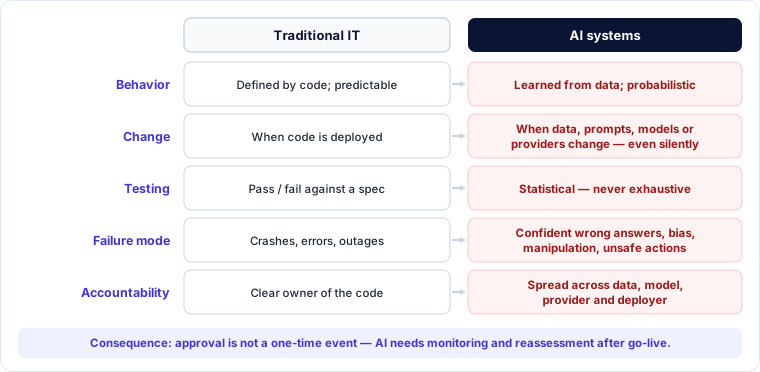
Five differences drive almost everything in this module:
- Behavior comes from data. Governance must cover the data used to build a system, not just its code. TalentMatch's rankings depend on whatever hiring decisions it was trained on.
- Outputs are probabilistic and can change silently. A vendor can retrain its model next week and the rankings change, with no change on Meridian's side.
- Decisions can affect people's rights. Fairness, explainability and human oversight become governance concerns, not just technical ones. Ranking job applicants affects their livelihoods.
- AI spreads without procurement. A manager with a credit card or a browser can start using AI in an afternoon, as TalentMatch shows. Governance must find AI, not just approve it.
- Regulation is AI-specific and arriving quickly.
The practical consequence is that AI governance should not be a separate silo. It extends structures the organization already has (enterprise risk management, the information security management system, data protection and procurement) with AI-specific roles, policies and checks. A bank that already runs model risk management for its credit models has a head start.
Exam lens. When a question asks for the first or best governance step, prefer answers that build on existing structures (extend the risk framework, add AI to the asset inventory, update procurement) over answers that create an entirely new, separate program.
The EU AI Act
The EU AI Act (Regulation (EU) 2024/1689) is the world's first comprehensive AI law [14]. Like the GDPR, it reaches beyond Europe. It applies to providers placing AI systems on the EU market, to deployers using AI systems in the EU, and to providers and deployers outside the EU whose AI output is used in the EU. TalentMatch's Bangalore developer and Meridian's Frankfurt branch are both in scope.
Risk tiers
The Act regulates by risk tier, shown in Figure 2.2.
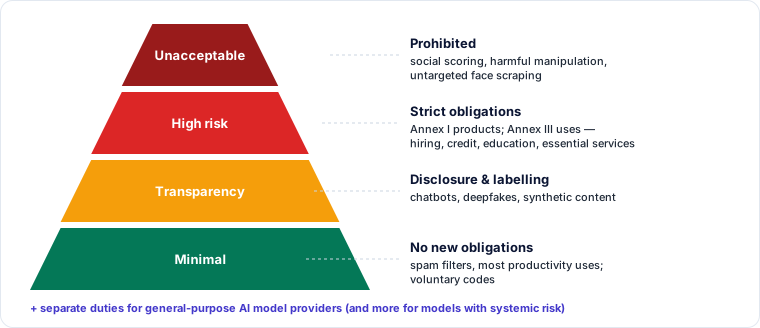
- Unacceptable risk practices are banned: for example social scoring by public authorities, AI that manipulates people harmfully or exploits their vulnerabilities, untargeted scraping of facial images to build recognition databases, and emotion recognition in workplaces and schools (with narrow exceptions). The 2026 Digital Omnibus added prohibitions on AI built to produce child sexual abuse material and non-consensual intimate imagery, applying from 2 December 2026 [15].
- High-risk systems are permitted but heavily regulated. They include AI that is a safety component of regulated products (Annex I) and stand-alone uses listed in Annex III, such as recruitment and worker management, creditworthiness assessment, access to education and essential services, law enforcement, migration and critical infrastructure.
- Transparency (often called limited risk): people must be told when they are interacting with an AI system such as a chatbot, and AI-generated or manipulated content such as deepfakes must be disclosed and machine-readably marked.
- Minimal risk, the large majority of uses (spam filters, most productivity tools), carries no new obligations, though voluntary codes are encouraged.
Separately, providers of general-purpose AI (GPAI) models, such as large foundation models, have their own duties (technical documentation, information for downstream providers, a copyright policy and a training-content summary), with extra duties for models with systemic risk. Every provider and deployer must also take measures to ensure AI literacy among its staff (section 2.7).
Worked example: classifying Meridian's AI
| Meridian system | Tier | Why |
|---|---|---|
| TalentMatch ranks job applicants in Frankfurt | High-risk | Recruitment and selection is listed in Annex III |
| Sentinel scores card payments for fraud | Usually not high-risk | Annex III excludes AI used to detect financial fraud from the creditworthiness category |
| A model that sets individual credit limits for EU customers | High-risk | Creditworthiness assessment of natural persons is in Annex III |
| HomeHelp mortgage chatbot for EU customers | Transparency | Customers must be told they are talking to AI |
| A spam filter on staff email | Minimal | No new obligations |
| An HR tool that infers staff emotions from webcam video during meetings | Prohibited | Emotion recognition in the workplace is banned (narrow medical and safety exceptions aside) |
Providers, deployers and their duties
The Act assigns duties by role:
- The provider develops an AI system (or has one developed) and places it on the market under its own name. It carries most obligations. For TalentMatch, that is the Bangalore start-up.
- The deployer uses the system in its own operations. For TalentMatch, that is Meridian.
- Importers and distributors have narrower duties. A deployer that substantially modifies a high-risk system, or puts its own name on it, can become its provider.
For high-risk systems, the provider must run a risk management system across the lifecycle; apply data governance to training, validation and test data; keep technical documentation and automatic logs; give deployers clear instructions for use; design for human oversight; achieve appropriate accuracy, robustness and cybersecurity; operate a quality management system; complete a conformity assessment before placing the system on the market; register it in the EU database; and run post-market monitoring, including reporting serious incidents.
The deployer must use the system according to its instructions, assign competent human oversight, monitor operation, keep the logs under its control, inform workers' representatives and affected workers before using high-risk AI in the workplace, and in certain cases (public bodies and some credit and insurance uses) carry out a fundamental rights impact assessment (section 2.3).
The timeline
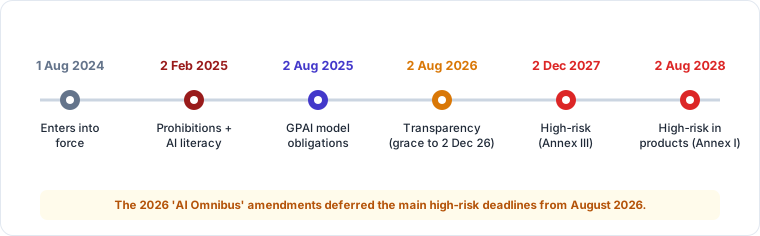
The Act entered into force on 1 August 2024 and applies in stages, shown in Figure 2.3. In July 2026 the EU adopted the Digital Omnibus on AI, Regulation (EU) 2026/1744, which entered into force on 27 July 2026. It moved the obligations for stand-alone Annex III high-risk systems from 2 August 2026 to 2 December 2027, and for high-risk AI embedded in regulated products to 2 August 2028 [15]. Prohibitions have applied since 2 February 2025, and GPAI obligations since 2 August 2025. Fines reach up to EUR 35 million or 7% of worldwide annual turnover for prohibited practices.
Exam lens. A deferred deadline is not a reason to wait. TalentMatch's high-risk obligations apply from December 2027, but the GDPR applies today, AI literacy has applied since February 2025, and Meridian's own risk appetite applies always. "The law doesn't bite yet, so do nothing" is never the best answer.
GDPR alongside the AI Act
Where an AI system processes personal data, the GDPR applies at the same time [16]. Three points come up repeatedly:
- a lawful basis is needed both to train and to use the system;
- a data protection impact assessment (DPIA) is required where processing is likely to result in high risk, which AI processing of personal data at scale usually is;
- Article 22 gives people the right not to be subject to a decision based solely on automated processing that produces legal or similarly significant effects, unless an exception applies and safeguards, including human intervention, are in place.
If TalentMatch automatically rejects candidates with no human review, Meridian is already exposed under Article 22 today, regardless of the AI Act's timeline. Indian learners should read India's Digital Personal Data Protection Act, 2023 and its 2025 Rules alongside this section [17]. Module 3 covers privacy controls in depth.
NIST AI RMF, ISO/IEC 42001 and ISO/IEC 23894
The AI Act says what the law requires. Frameworks and standards help an organization build the program that meets it.
The NIST AI Risk Management Framework (AI RMF 1.0) is voluntary and widely used worldwide [10]. Its core has four functions, Govern, Map, Measure and Manage, covered in section 2.3. Its Generative AI Profile (NIST AI 600-1) lists risks specific to generative AI with suggested actions [11].
ISO/IEC 42001 specifies an AI management system (AIMS) [12]. It follows the same high-level structure as ISO/IEC 27001 (context, leadership, planning, support, operation, performance evaluation, improvement), so an organization with an ISMS can extend it rather than start again. It requires an AI policy, AI risk assessment and treatment, AI system impact assessment, and a set of controls in its Annex A, and it can be certified by an accredited body.
ISO/IEC 23894 gives guidance on AI risk management within the general ISO 31000 risk process [13], and ISO/IEC 42005 gives guidance on AI system impact assessment [26].
Worked example: which one does Meridian need?
| Request from Meridian's leadership | Best fit | Why |
|---|---|---|
| "Does any law tell us what we must do about TalentMatch?" | EU AI Act (with GDPR) | Only these are binding law |
| "Regulators want assurance we manage AI properly, ideally with an external certificate." | ISO/IEC 42001 | The certifiable AI management system |
| "Give us a flexible structure and vocabulary for our AI risk program." | NIST AI RMF | Voluntary, widely adopted, function-based |
| "Our enterprise risk team uses ISO 31000. How do we fold AI into it?" | ISO/IEC 23894 | AI risk guidance built on ISO 31000 |
| "How do we assess TalentMatch's effects on candidates and society?" | ISO/IEC 42005 (and the AI Act's FRIA where required) | Impact assessment guidance |
These are not alternatives you pick one of. A mature organization often uses all of them: ISO/IEC 42001 as the management system, the NIST AI RMF as the risk vocabulary, and the AI Act and GDPR as the legal requirements the system must meet.
The AI policy framework
Governance becomes real through documents with different levels of authority [5], shown in Figure 2.4.
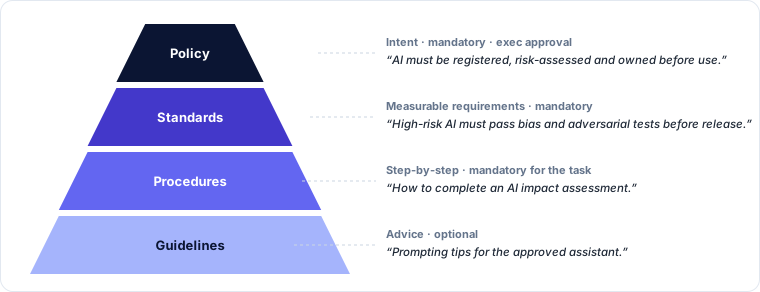
- A policy states management's intent and is mandatory. It changes rarely and is approved at executive level.
- Standards set specific, measurable mandatory requirements that implement the policy.
- Baselines set minimum configurations for a particular platform.
- Procedures give step-by-step instructions for a task.
- Guidelines give recommended, optional advice.
Exercise: put each requirement at the right level
Meridian's draft AI rules are all in one long document. Place each at the right level before reading the answers.
| Draft requirement | Level | Reasoning |
|---|---|---|
| "No AI system that makes or informs decisions about customers or staff may be used without approval from the AI governance committee." | Policy | Management intent; broad and stable |
| "High-risk AI must pass bias testing with an impact ratio of at least 0.8 before release." | Standard | Specific, measurable, mandatory |
| "The approved LLM gateway must log prompts and responses for 90 days with personal data masked." | Baseline | Minimum configuration for one platform |
| "To request approval for a new AI use, complete form AI-01, attach the vendor questionnaire and submit to the AI office." | Procedure | Step-by-step task |
| "When using the approved assistant, give it the context of your task and check its sources." | Guideline | Helpful advice, not mandatory |
Putting a specific threshold like "0.8" into a policy is a common mistake: every time the threshold changes, the board has to re-approve the policy. Putting "AI must be approved" into a guideline is worse: it makes a mandatory control optional.
A typical AI policy set includes an overarching AI policy (principles, scope, roles, risk tiers and approval); an acceptable use policy for AI covering what staff may and may not put into AI tools; and standards for model development, third-party AI, data use for AI and AI incident handling. The acceptable use policy matters most for the everyday risk of staff pasting confidential or personal data into public AI services.
The AI inventory
You cannot govern what you do not know about. An AI inventory (or register) records every AI system and use case, including AI features inside purchased software and services. Figure 2.5 shows a complete record.
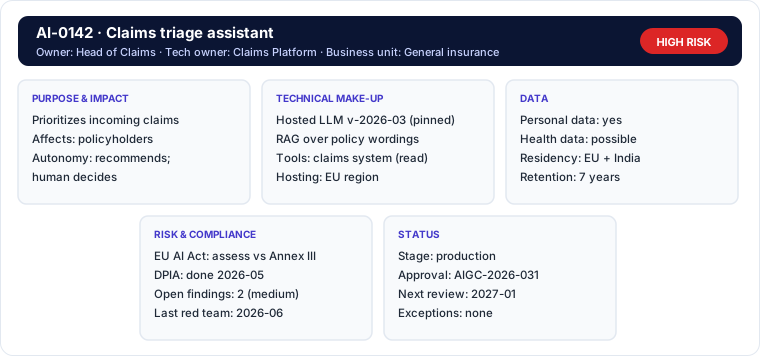
At minimum each entry records:
- purpose and impact: what the system does, who is affected, and how much autonomy it has;
- owners: the accountable business owner and the technical owner;
- technical make-up: model, version, vendor, hosting location, retrieval sources and tools;
- data: personal or sensitive data, residency and retention;
- risk and compliance: risk tier, regulatory classification, assessments completed, open findings;
- status: lifecycle stage, approval reference and next review date.
The inventory is the backbone of everything else: risk assessment, audit, incident response and regulatory reporting all start from it. When the auditor asked about TalentMatch, the absence of an inventory entry was itself the finding.
Intake: how AI enters the organization
An inventory is only complete if nothing can go live without passing through it. That is the job of an AI intake workflow (Figure 2.6): one front door through which every proposed AI use passes, triaged by risk so that low-risk uses are not slowed down.
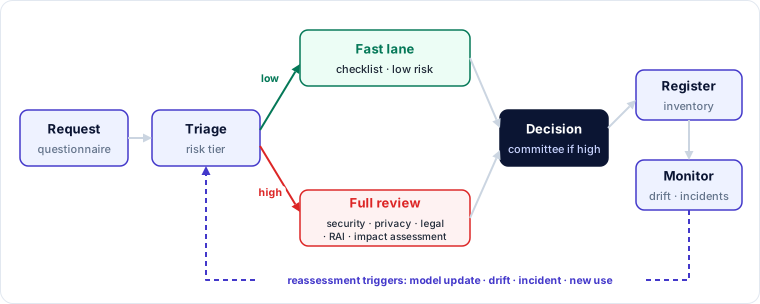
- Request. The requester completes a short questionnaire: what the AI does, what data it uses, who it affects, whether it decides or recommends.
- Triage. The answers place the use in a risk tier (section 2.3).
- Fast lane or full review. A low-risk use (an approved assistant for drafting internal emails) passes a checklist in days. A high-risk use gets security, privacy, legal and responsible-AI review and an impact assessment.
- Decision. High-risk uses are approved by the AI governance committee.
- Register. Every approved use gets an inventory entry before go-live.
- Monitor. Drift, incidents and reassessment triggers feed back into review.
The fast lane is not a nicety. If the intake process is slow for everything, staff route around it, and you get more TalentMatches, not fewer.
Three channels keep the inventory complete:
- Intake: nothing goes live without an entry.
- Procurement: purchasing and vendor onboarding ask "does this product use AI?" and route yes answers to intake. TalentMatch went through as ordinary software because nobody asked.
- Discovery: shadow AI detection finds what slipped past the first two (section 2.6).
Roles and decision rights
AI governance needs named people with clear authority [1][2]. Figure 2.7 shows the typical cast around the AI governance committee.
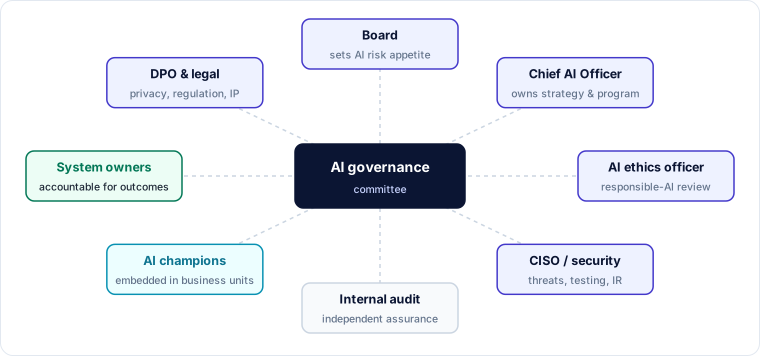
| Role | Typical responsibility |
|---|---|
| Board | Sets the risk appetite for AI and oversees the program |
| Chief AI Officer (or equivalent executive) | Owns the AI strategy and governance program |
| AI governance committee | Cross-functional body (business, risk, security, privacy, legal, ethics, technology) that approves high-risk uses and AI policies |
| AI ethics officer or responsible AI lead | Advises on fairness, transparency and societal impact; can escalate concerns |
| Business (use-case) owner | Accountable for a specific AI system's outcomes and risks |
| Technical (model) owner | Responsible for performance, documentation and monitoring |
| CISO / security | Sets security requirements, tests, monitors and responds to AI incidents |
| DPO / privacy and legal | Lawful processing, DPIAs, regulatory interpretation, intellectual property |
| Internal audit | Independent assurance that the program works |
| AI champions | Promote good practice inside business teams |
The exam often asks who should decide something, and the pattern is consistent. The business owner is accountable for the use and its risks. The committee approves high-risk uses within the board's appetite. Security advises, tests and implements controls, but does not own the business decision or accept business risk on the business's behalf. Internal audit gives independent assurance and must not design the controls it later audits.
Security lens. A security team that "approves" AI uses on its own sounds strong but is a governance weakness: it makes security the owner of business risk, and it puts security in the path of decisions about fairness, legality and ethics that it is not qualified to make alone. Your job is to make sure the right people decide, with the right information.
The opening case, resolved
- Why it is a governance failure even without a breach: TalentMatch makes decisions that affect people's livelihoods, with no owner, no inventory entry, no risk assessment, no bias testing, no transparency to candidates and no legal classification. Every one of those is a control that failed to operate. The harm may already be happening, unseen.
- Which law applies: recruitment is an Annex III high-risk use under the EU AI Act, and Meridian is the deployer (the Bangalore start-up is the provider). Full high-risk obligations apply from 2 December 2027, but the GDPR applies now: Meridian needs a lawful basis, almost certainly a DPIA, and if candidates are rejected without human review, Article 22 safeguards. AI literacy duties also already apply.
- Three mechanisms that would have caught it: 1. procurement asking "does this use AI?" and routing the purchase to intake; 2. an intake workflow that tiers recruitment AI as high-risk and sends it to full review and committee approval; 3. an AI inventory that makes ownerless AI visible, backed by shadow AI discovery for anything that slips through.
- What to do now: register TalentMatch, name a business owner, suspend fully automated rejection until human review is in place, request the provider's documentation and bias testing, run a DPIA, and decide through the committee whether to continue.
Check your understanding
Try each before reading the reasoning.
1. A US software company sells an AI tool that scores the creditworthiness of individual borrowers to banks in Spain. It has no EU office. Does the EU AI Act apply, and in which role?
Reasoning: yes. The Act applies to providers placing AI systems on the EU market regardless of where they are established. The company is the provider of a high-risk system (creditworthiness assessment of natural persons is in Annex III), and the Spanish banks are deployers.
2. Meridian's CISO proposes that the security team should review and approve all new AI uses, "since AI is a security risk". What is the best response?
Reasoning: security should be a mandatory reviewer in intake, but approval of high-risk uses belongs to a cross-functional committee within the board's appetite, and accountability belongs to the business owner. AI risk includes fairness, legality and ethics, which security cannot judge alone, and security should not accept business risk on the business's behalf.
3. A team asks whether its AI standard should say "bias testing must achieve an impact ratio of at least 0.8" or whether that belongs in the AI policy. Where should it go, and why?
Reasoning: in a standard. It is a specific, measurable, mandatory requirement that may change as practice matures. The policy should state the intent (for example, "AI must not produce unjustified disadvantage for protected groups"), so that adjusting a threshold does not require board approval.
Key takeaways
- AI governance extends existing governance to systems whose behavior comes from data, changes silently, affects people's rights and spreads without procurement.
- The EU AI Act regulates by risk tier and by role. Recruitment and credit scoring are high-risk; chatbots carry transparency duties; some practices are banned. Know the provider and deployer duties.
- The Digital Omnibus moved Annex III high-risk deadlines to 2 December 2027, but the GDPR, prohibitions and AI literacy already apply.
- Law (EU AI Act, GDPR), management system (ISO/IEC 42001), risk framework (NIST AI RMF, ISO/IEC 23894) and impact assessment (ISO/IEC 42005) work together.
- Put intent in policy, measurable requirements in standards, configurations in baselines, steps in procedures and advice in guidelines.
- The inventory, an intake workflow with a fast lane, and procurement and discovery checks keep AI visible.
- Business owners are accountable, the committee approves high-risk uses, security advises and tests, and audit assures.