
Authorisation for agents and the AI identity lifecycle
In this lesson you will:
- Apply least privilege and separation of duties across models and agentic workflows
- Choose between RBAC, ABAC, PBAC and just-in-time access for AI
- Set execution boundaries and API scope limitations
- Prevent excessive agency, over-delegation and lateral movement by agents
- Manage AI identity inventories, provisioning, access reviews, ISPM and resource-use audits
Authentication says who an agent is. Authorisation decides what it may do — and for agents, that decision has to be made constantly, at the level of individual tool calls.
1. Least privilege and separation of duties
Least privilege (PoLP) for AI means:
- Each agent gets only the tools, scopes and data its task needs — not everything its owner can access.
- Permissions are task-scoped and time-bound where possible.
- Read and write capabilities are separate; destructive capabilities (delete, transfer, deploy) are rare and gated.
Separation of duties (SoD) applies to agentic workflows too:
- The agent that proposes a payment should not also approve it.
- An agent that writes code should not be able to merge and deploy it without independent review.
- A model-development pipeline identity should not promote its own models (Module 5).
- In multi-agent systems, avoid one agent holding a complete set of conflicting permissions.
2. Authorisation models
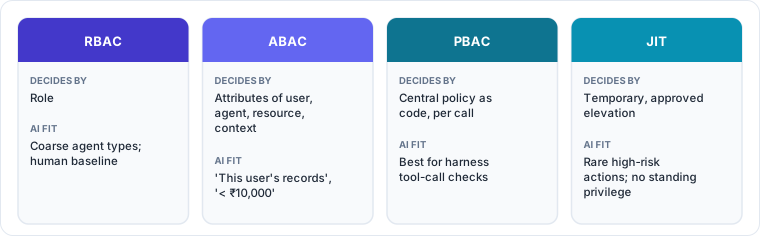
| Model | How it decides | Fit for AI |
|---|---|---|
| RBAC (role-based) | Permissions attached to roles | Good baseline for humans and coarse agent roles; too coarse for per-call decisions |
| ABAC (attribute-based) | Attributes of user, agent, resource, action and context | Good for "this user's records only", "amounts under ₹10,000", "business hours" |
| PBAC (policy-based) | Central, versioned policies evaluated by a policy engine (policy as code) | Best fit for agent harnesses: consistent, auditable, testable decisions per tool call |
| JIT (just-in-time) | Temporary elevation for a specific task, often approved | For rare high-risk actions; no standing privilege |
In practice: RBAC defines which agent types exist; ABAC/PBAC decide each tool call; JIT covers exceptions.
3. Execution boundaries and API scope limitations
- API scopes — OAuth scopes narrowed to specific operations (
invoices.read, noterp.admin). - Resource boundaries — specific projects, mailboxes, folders, tenants.
- Network boundaries — agents can reach only the endpoints their tools need.
- Quantitative boundaries — amounts, counts, rates and time windows.
- Environmental boundaries — test agents cannot reach production; sandboxes for code.
4. Excessive agency, over-delegation and lateral movement
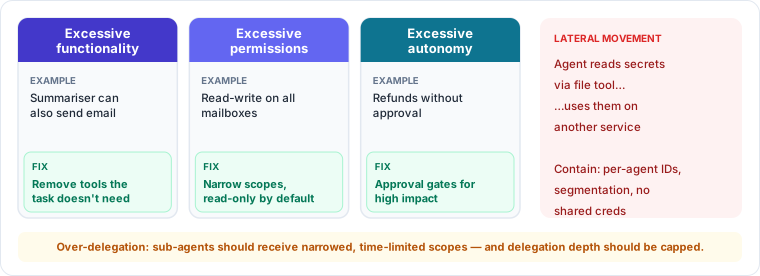
Excessive agency (an OWASP LLM Top 10 risk) has three components:
- Excessive functionality — tools the task doesn't need (a summariser that can also send email).
- Excessive permissions — tools with broader rights than needed (read-write when read-only would do; all mailboxes instead of one).
- Excessive autonomy — high-impact actions without human approval.
Over-delegation — passing broad authority down a chain of agents, so a sub-agent ends up with more power than its task needs. Delegate narrowed, time-limited scopes, and cap delegation depth.
Lateral movement by agents — a compromised or manipulated agent uses its credentials and tool access to reach other systems — for example, reading secrets from a file system tool, then using them against another service. Contain it with per-agent identities, network segmentation, no shared credentials, and monitoring for unusual tool sequences.
5. Identity lifecycle and auditing
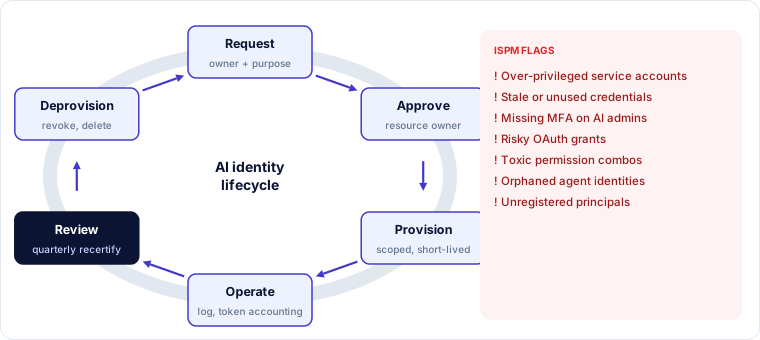
- AI identity inventory — every human and non-human identity used by AI systems, with owner, purpose, scopes, credentials and linked use case. Link it to the AI use-case inventory.
- Provisioning — identities created through a request with an owner and justification; scopes approved by the resource owner.
- Deprovisioning — when an agent is retired, its project ends or its owner leaves: revoke tokens, delete credentials, remove grants. Orphaned agent identities are a classic gap.
- Periodic access reviews — owners recertify agent scopes, as they do for humans; unused permissions are removed.
- Identity Security Posture Management (ISPM) — tools that continuously analyse identity configurations for risk: over-privileged service accounts, stale credentials, missing MFA, risky OAuth grants, toxic permission combinations.
- Audit of AI resource utilisation — token accounting per identity, rate-limit hits, session timeouts, spend per agent. Anomalies can reveal compromise, abuse or runaway loops.
Worked example — a quarterly agent access review
| Agent | Finding | Action |
|---|---|---|
| Sales-research agent | Holds crm.write but only ever reads |
Reduce to crm.read |
| HR policy assistant | Retrieval covers all HR folders including investigations | Restrict index to published policies only |
| Deploy-helper agent | Owner left the company 2 months ago; token still valid | Disable, revoke, assign new owner or retire |
| Finance AP agent | Uses token exchange; scopes match task | No change |
| Coding agent | Can merge to main without review | Enforce branch protection; agent may open pull requests only |
| Unknown service principal calling model API | Not in inventory | Investigate as possible shadow AI; block until registered |
🔐 Security lens
Ask of every agent: "If this agent were fully controlled by an attacker for an hour, what could they do?" The answer is its real privilege — design it down until you can accept it.
Key takeaways
- Least privilege and separation of duties apply to agents: task-scoped, time-bound, separate read/write, no single agent with conflicting powers.
- RBAC for coarse roles; ABAC/PBAC for per-call decisions in the harness; JIT for rare elevation.
- Set boundaries on scopes, resources, networks, quantities and environments.
- Excessive agency = too much functionality, permission or autonomy; over-delegation and lateral movement extend the damage.
- Keep an AI identity inventory, provision and deprovision deliberately, review access, use ISPM and audit resource use.
Self-check
- Give an example of each of the three components of excessive agency.
- Why is PBAC a good fit for agent harnesses?
- What should happen to an agent's identity when its owner leaves the organisation?