
AI-specific privacy and IP: erasure, derivation, contamination and consent
In this lesson you will:
- Identify regulated and sensitive data types that need special handling in AI
- Explain the right to erasure for trained models and the options for honouring it
- Describe data derivation and regulatory contamination risks
- Assess IP, copyright and licensing issues in training data
- Apply consent mechanisms for data collection and public-data use
Some privacy problems only appear once data meets a model. A database row can be deleted; what a model learned from it cannot simply be "un-learned". This lesson covers the issues that make AI data different.
1. Regulated and sensitive data types
| Type | Examples | Typical constraint |
|---|---|---|
| PII / personal data | Names, contact details, identifiers, online identifiers | Lawful basis, minimisation, rights |
| Sensitive / special-category data | Health, biometrics, religion, sexual orientation, political opinions | Stricter conditions; often explicit consent or specific legal grounds |
| PHI | Medical records, diagnoses linked to individuals | HIPAA and health-sector rules |
| Financial data | Account numbers, card data, credit history | PCI DSS, banking secrecy and sector rules |
| Children's data | Data of minors | Parental consent (e.g. verifiable parental consent under DPDP) |
| Export-controlled data | Technical data on controlled technologies | Export-control law restricts who and where it can be processed — including by an AI provider abroad |
| Confidential business data | Trade secrets, M&A plans, source code | Contractual and IP protection |
2. Erasure and the trained model
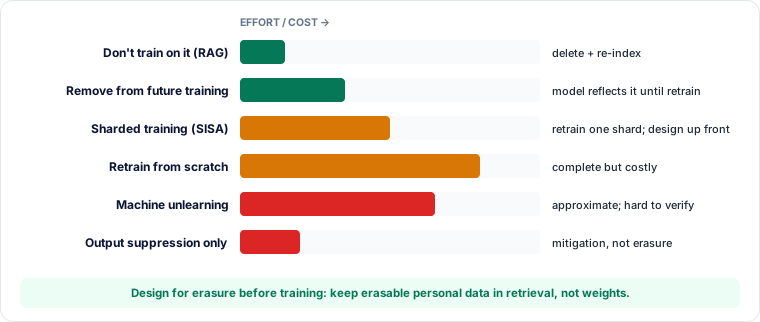
When someone exercises a right to erasure (GDPR Article 17; erasure rights under the DPDP Act), deleting their records from source systems is straightforward. But a model trained on those records may still reflect them, and in some cases can reproduce them.
| Option | How | Notes |
|---|---|---|
| Don't train on it | Keep personal data in retrieval stores, not weights | Easiest erasure: delete the record and re-index |
| Remove from future training | Delete from datasets; next scheduled retrain excludes it | Model still reflects data until retrained |
| Retrain from scratch | Retrain without the data | Most complete; expensive for large models |
| Sharded / modular training | Train sub-models on data shards (e.g. SISA approach) so only one shard is retrained | Must be designed in from the start |
| Machine unlearning | Algorithms that approximately remove a record's influence | Active research; verification is hard |
| Output suppression | Filter outputs that reproduce the person's data | A mitigation, not erasure |
Design implication: prefer RAG over fine-tuning for personal data that may need to be erased, and keep training datasets versioned so you can rebuild without specific records.
3. Data derivation and regulatory contamination
Derived data is anything computed from source data: features, embeddings, summaries, labels, model weights. It frequently inherits the source's sensitivity and legal restrictions.
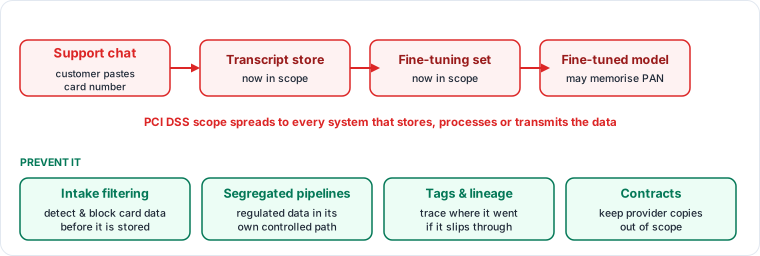
Regulatory contamination occurs when regulated data enters a pipeline and brings the whole pipeline — and its outputs — into a regulatory regime.
Examples:
- Card numbers pasted into support chats flow into transcripts used for fine-tuning — now the fine-tuning pipeline, storage and possibly the model are in PCI DSS scope.
- Export-controlled engineering documents are indexed into a global vector store accessible to staff in restricted countries.
- Health data mixed into a general analytics dataset brings HIPAA-style obligations to every downstream user.
Prevent contamination with intake filtering (detect and block regulated data before it enters pipelines), segregated pipelines for regulated data, tagging and lineage so contamination can be traced, and contracts that keep provider-side copies out of scope.
4. IP, copyright and licensing of training data
- Copyright — training on copyrighted works raises unresolved legal questions in many jurisdictions; litigation is ongoing and outcomes differ by country. Text-and-data-mining exceptions exist in some places (for example the EU, with an opt-out for rights holders), but not uniformly.
- Licences — datasets and models come with licences that can restrict commercial use, require attribution, or prohibit certain fields of use. Mixing differently licensed sources can create conflicts.
- Terms of service — scraping websites can breach their terms even where copyright allows it.
- Outputs — models can reproduce training content verbatim; output filtering and similarity checks reduce infringement risk.
- Your own IP — prompts and documents sent to a vendor may be used for training unless contracts prevent it.
Controls: a licence register for datasets and models (part of the AIBOM); legal review of sources; honouring machine-readable opt-outs; vendor IP indemnities; output similarity checks for generative use.
5. Consent and public data
- Consent must be specific, informed and freely given. Bundling "we may use your data to improve our AI" into terms of service is weak consent — and under GDPR may not be valid for that purpose.
- Granular choices — separate opt-ins for service delivery, analytics and model training.
- Withdrawal — must be as easy as giving consent, and must flow through to future training sets.
- "Publicly available" is not "free to use". Personal data posted publicly is still personal data; scraping it for training needs a lawful basis, must respect purpose limits and platform terms, and may conflict with the expectations of the people involved.
- Consent managers — under India's DPDP framework, registered consent managers let individuals give, manage and withdraw consent across services.
Worked example — an erasure request against a fine-tuned support model
A customer asks a telecom company to erase all their data. Their chat transcripts were part of a dataset used to fine-tune the support assistant six months ago.
| Action | Detail |
|---|---|
| Delete source records | CRM, transcript store, backups on rotation |
| Re-index retrieval | Their account notes removed from the vector index within 24 hours |
| Training data | Transcripts removed from the versioned fine-tuning dataset |
| The model | Next quarterly retrain excludes the data; meanwhile, an output filter blocks the customer's name, number and address |
| Record | Erasure log entry noting the model will be retrained on (date), for the privacy office and auditors |
| Lesson for design | New personal-data use cases move to retrieval rather than fine-tuning |
🔐 Security lens
Memorisation is both a privacy issue and an attack surface: extraction attacks (Module 7) try to make models regurgitate training data. Erasure design and extraction defences reinforce each other.
Key takeaways
- Know the regulated categories — PII, special-category, PHI, financial, children's and export-controlled data — and their extra constraints.
- Erasure in models ranges from easy (RAG) to hard (unlearning); design for it before training.
- Derived artefacts inherit sensitivity; regulated data contaminates pipelines unless filtered and segregated.
- Training-data IP is legally unsettled; keep a licence register, honour opt-outs and filter outputs.
- Public data is still personal data; consent must be specific, granular and withdrawable.
Self-check
- Why is RAG preferable to fine-tuning for data that may be subject to erasure requests?
- Give an example of regulatory contamination in an AI pipeline.
- Why is "it was publicly available" not enough justification to train on personal data?