
Third-party AI: due diligence, contracts and shared responsibility
In this lesson you will:
- Perform security due diligence on AI vendors and model providers
- Specify procurement controls, security SLAs and incident notification rights
- Apply shared responsibility models to SaaS AI, model APIs and self-hosted models
- Evaluate vendor certifications and assessment reports
Most organisations buy far more AI than they build: AI features inside SaaS products, hosted model APIs, AI agents from vendors, open-weight models from public hubs. Each brings someone else's data practices, security and model behaviour into your environment.
1. Shared responsibility
As with cloud computing, responsibility depends on the delivery model.
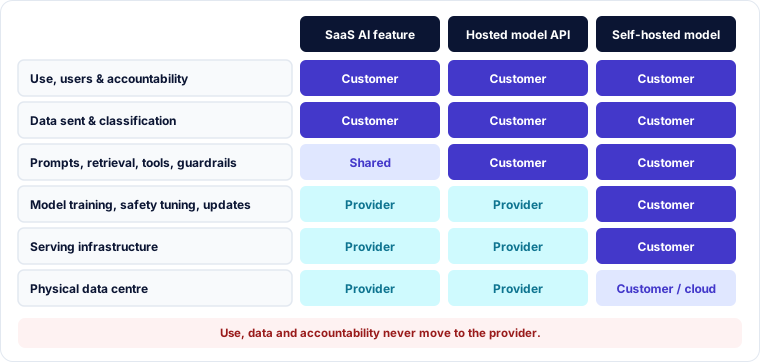
| Layer | SaaS AI feature | Hosted model API | Self-hosted open model |
|---|---|---|---|
| How it is used, by whom, for what | Customer | Customer | Customer |
| Data you send and its classification | Customer | Customer | Customer |
| Prompts, retrieval, tools, guardrails | Mostly provider (configurable) | Customer | Customer |
| Model training, safety tuning, updates | Provider | Provider | Customer (after download) |
| Serving infrastructure and scaling | Provider | Provider | Customer |
| Physical data centre | Provider | Provider | Customer or cloud provider |
What never moves: accountability for lawful, fair and safe use, and for the data you put in.
2. Due diligence
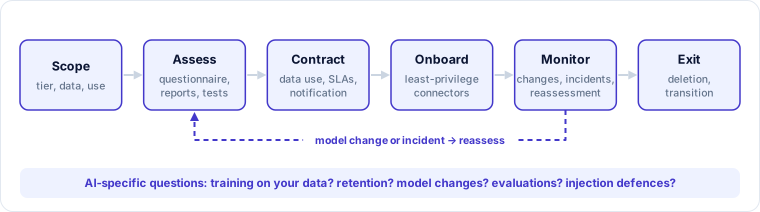
Key questions for AI vendors, beyond standard security questionnaires:
Data handling
- Is customer data (prompts, files, outputs) used to train or improve models? Can that be switched off by contract?
- Where is data processed and stored? What sub-processors are used?
- How long are prompts and outputs retained, including in logs and abuse-monitoring systems?
Model and safety
- Which model(s) and versions are used? How are customers told about changes?
- What evaluations — safety, bias, robustness — have been done? Are results shared?
- What protections exist against prompt injection and jailbreaks?
Security
- How are tenants isolated? How are API keys, tool credentials and connectors secured?
- Is the vendor's AI tested by independent red teams? How are findings handled?
- What logging is available to customers for investigations?
Transparency and compliance
- Model or system cards, training-data summaries, AIBOM.
- Certifications (ISO/IEC 27001, ISO/IEC 42001), assurance reports (SOC 2 Type II), regulatory status (EU AI Act role and classification).
Reading certifications and reports critically
- Check scope: does the SOC 2 report or ISO certificate actually cover the AI service and the regions you use?
- Check period and type: a Type II report covers operating effectiveness over a period; Type I is a point in time.
- Read exceptions and complementary user entity controls — controls the vendor assumes you operate.
- A certificate is evidence of a management system, not proof that a specific model is safe.
3. Procurement controls and contract terms
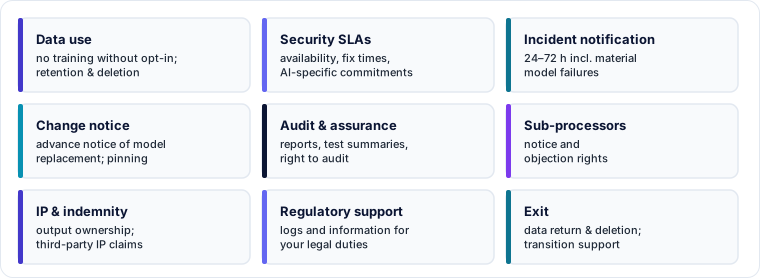
- Data use restrictions — no training on customer data without explicit opt-in; retention limits; deletion on exit.
- Security SLAs — availability, vulnerability remediation timelines, and security commitments specific to the AI service.
- Incident notification rights — notification within a defined period (for example 24–72 hours) for security incidents, data exposure and material model failures, with cooperation in investigation.
- Change notification — advance notice of model replacements or material behaviour changes; ability to pin versions where possible.
- Audit and assurance rights — reports, questionnaires, penetration-test summaries, right to audit for critical services.
- Sub-processor controls — notice and objection rights.
- IP and indemnity — ownership of outputs; indemnity for third-party IP claims arising from model output.
- Regulatory cooperation — support for impact assessments, logs and information the customer needs to meet its own legal duties.
- Exit — data return and deletion, transition support, continued access to logs.
Procurement controls make these stick: AI services cannot be purchased without an intake record; security and privacy review before contract signature; card-spend monitoring for AI vendors (a shadow-AI signal).
Worked example — reviewing an AI note-taker vendor
| Finding | Risk | Action |
|---|---|---|
| Default terms allow use of meeting transcripts to improve models | Confidential data leaves your control | Enterprise tier with training opt-out confirmed in the contract |
| SOC 2 Type II covers core platform; AI summarisation launched after the audit period | Assurance gap for the feature you want | Request bridge letter and the vendor's AI security testing summary |
| Transcripts retained 3 years | Excess retention; DPDP/GDPR erasure duties | Contract retention of 90 days, deletion on request |
| No model-change notifications | Silent behaviour changes | Clause for 30 days' notice of model replacement |
| Calendar connector requests full mailbox access | Over-broad scope | Configure least-privilege scopes; block full-mailbox grant |
Decision: approve the enterprise tier with conditions; reassess at contract renewal or on any vendor incident.
🔐 Security lens
The OAuth scopes a vendor's AI connector asks for are part of due diligence. "Read and send all mail" granted to a meeting bot is a blast-radius decision, whatever the vendor's certification says.
Key takeaways
- Responsibility shifts with the delivery model, but use, data and accountability always stay with the customer.
- AI due diligence adds questions on training use of your data, retention, model changes, evaluations, injection defences and tenant isolation.
- Read certifications for scope, period, exceptions and the controls they expect you to run.
- Contracts should cover data use, security SLAs, incident and model-change notification, audit rights, IP indemnity, regulatory cooperation and exit.
Self-check
- In a hosted model API, who is responsible for retrieval and guardrails?
- What is a complementary user entity control, and why does it matter?
- Name three AI-specific clauses you would add to a standard SaaS contract.