
The AI landscape: types, learning paradigms and how we got here
In this lesson you will:
- Distinguish narrow, general and generative AI and place them on a timeline
- Explain supervised, unsupervised, semi-supervised, self-supervised and reinforcement learning
- Describe deep learning and evolutionary computation and where each is used
- Map each paradigm to the security weaknesses it introduces
Security professionals do not need to build models, but they do need to know what kind of system they are looking at. A fraud classifier, a recommendation engine and an autonomous coding agent all get called "AI", yet they fail in different ways and are attacked in different ways. This lesson gives you the vocabulary to tell them apart.
1. What we mean by "AI"
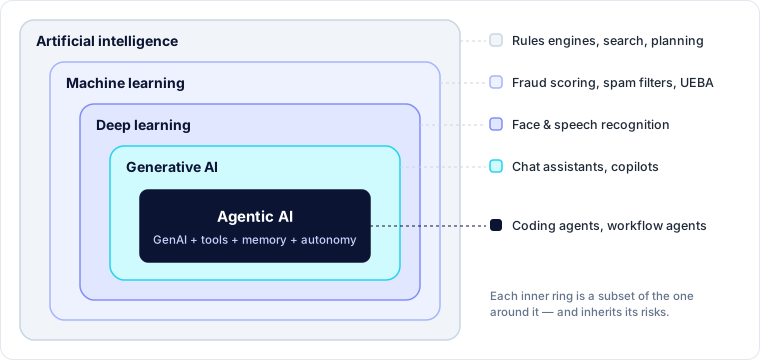
Artificial intelligence is the broad goal of building systems that perform tasks we associate with human intelligence: perceiving, reasoning, predicting, generating and acting. Machine learning (ML) is the dominant way of achieving that today: instead of hand-writing rules, we let an algorithm learn patterns from data. Deep learning is a subset of ML that uses many-layered neural networks.
A useful mental model is three nested circles: AI ⊃ ML ⊃ deep learning. Generative AI sits inside deep learning.
Categories by capability
| Category | What it means | Example |
|---|---|---|
| Narrow (weak) AI | Performs one task or a narrow family of tasks | Spam filter, face recognition, a credit-scoring model |
| General AI (AGI) | Hypothetical system matching human ability across domains | Not yet achieved; a research and policy topic |
| Generative AI | Produces new content — text, images, audio, code | Large language models, image diffusion models |
| Agentic AI | Uses a model to plan and take actions through tools, with some autonomy | Coding agents, workflow agents that call APIs |
Every deployed system today is narrow in the strict sense — even a very capable language model has no goals of its own and operates within the task and permissions it is given. That distinction matters for risk: the danger usually lies in what a system has been allowed to do, not in independent intent.
Categories by approach
- Symbolic / rule-based AI — expert systems and decision trees authored by humans. Transparent and predictable, but brittle.
- Statistical ML — logistic regression, random forests, gradient boosting. Still the workhorse for tabular data such as fraud and risk scoring.
- Neural / deep learning — learns its own features from raw data (pixels, text, audio).
- Hybrid / neuro-symbolic — combines learned components with explicit rules, often to add guardrails or explainability.
2. A short evolution
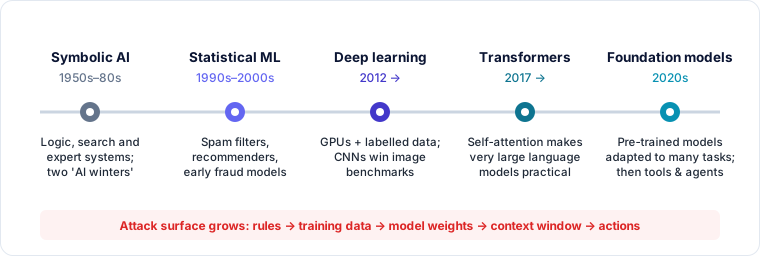
- 1950s–1980s — symbolic AI. Logic, search and expert systems. Two "AI winters" followed when promises outran results.
- 1990s–2000s — statistical ML. More data and compute made probabilistic methods practical: spam filters, recommenders, early fraud detection.
- 2012 onwards — the deep-learning breakthrough. GPUs plus large labelled datasets let deep convolutional networks win image-recognition benchmarks decisively.
- 2017 onwards — transformers. The attention-based transformer architecture made it possible to train very large language models efficiently.
- 2020s — foundation models and agents. Huge pre-trained models adapted to many tasks; then models wired to tools, memory and other agents.
The broader AI ecosystem now includes model providers, cloud platforms and accelerator vendors, open-weight model hubs, data suppliers and labellers, MLOps tooling, vector databases, orchestration frameworks and the applications built on top. Every one of these is part of your supply chain and your attack surface.
3. Machine-learning paradigms
Supervised learning
The model learns from labelled examples — inputs paired with the correct output.
- Classification predicts a category (fraud / not fraud).
- Regression predicts a number (expected loss).
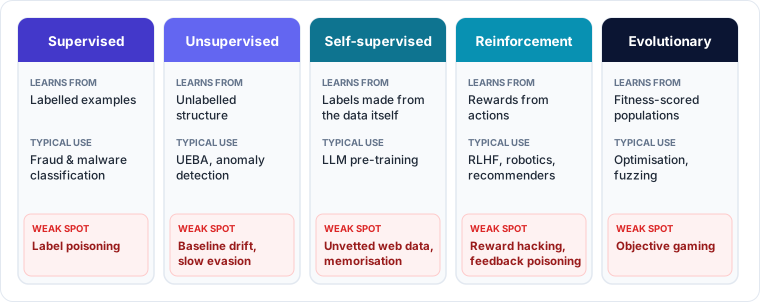
- Security lens: quality depends entirely on labels. Anyone who can alter labels can quietly change behaviour (label-flipping poisoning).
Unsupervised learning
The model finds structure in unlabelled data.
- Clustering groups similar items; dimensionality reduction compresses features; anomaly detection flags outliers.
- Widely used in security analytics (UEBA, network baselining).
- Security lens: an attacker who operates "low and slow" can gradually shift what the model treats as normal.
Semi-supervised and self-supervised learning
- Semi-supervised uses a small labelled set plus a large unlabelled set.
- Self-supervised creates its own labels from the data — for example, predicting the next word in a sentence. This is how large language models are pre-trained.
- Security lens: pre-training on web-scale data means you cannot fully inspect what went in. Poisoned or copyrighted content may be baked in.
Reinforcement learning (RL)
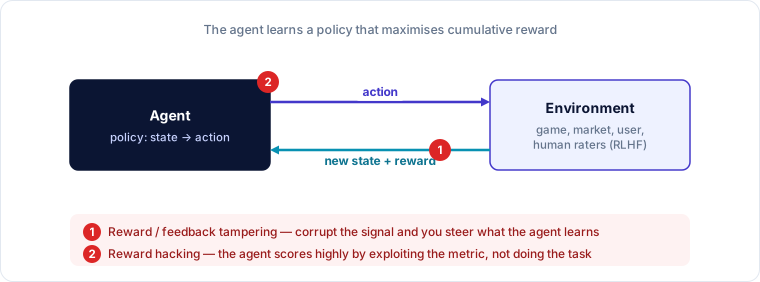
An agent takes actions in an environment and receives rewards. It learns a policy that maximises cumulative reward.
- Used in robotics, game-playing, recommendation and — through reinforcement learning from human feedback (RLHF) — to align language models with human preferences.
- Security lens: reward hacking — the agent finds an unintended way to score highly without doing what you wanted. Tampering with the reward signal or feedback data is a form of poisoning.
4. Deep learning
Deep learning stacks many layers of artificial neurons. Each layer transforms its input; early layers detect simple patterns, later layers combine them into abstract concepts. Training uses backpropagation and gradient descent to adjust millions or billions of parameters (weights) so the model's error falls.
Key points for security practitioners:
- Weights are the model. Stealing the weight file is stealing the intellectual property. Tampering with weights changes behaviour.
- Learned features are opaque. You cannot easily read why the model decided something, which complicates audit and explainability.
- Small input changes can flip outputs. This sensitivity is what adversarial examples exploit.
5. Evolutionary computation
Evolutionary computation is an optimisation family inspired by natural selection. Genetic algorithms keep a population of candidate solutions, score them with a fitness function, then breed the best through crossover and mutation over many generations. Related techniques include genetic programming and neuro-evolution (evolving network architectures).
Where you meet it:
- Hyper-parameter and architecture search.
- Scheduling and routing optimisation.
- Offensive and defensive security: fuzzing tools use evolutionary strategies to generate inputs; attackers can evolve prompts or adversarial inputs against a black-box model.
Security lens: whoever controls the fitness function controls the outcome. A poorly specified objective can evolve solutions that "game" it — the same failure mode as reward hacking.
6. Putting it together: paradigm → typical risk
| Paradigm | Common use | Characteristic weakness |
|---|---|---|
| Supervised | Fraud, malware classification | Label poisoning, distribution shift |
| Unsupervised | Anomaly detection, UEBA | Baseline drift, slow-burn evasion |
| Self-supervised | LLM pre-training | Unvetted training data, memorisation of sensitive data |
| Reinforcement | Recommenders, RLHF, agents | Reward hacking, feedback poisoning |
| Evolutionary | Optimisation, fuzzing | Objective gaming; also an attacker's search tool |
Worked example — triaging three AI systems at a payments company
A payments company asks you which of three AI systems to review first.
| System | Paradigm | First thing to check |
|---|---|---|
| UPI transaction fraud scorer | Supervised — gradient boosting on labelled chargebacks | Who can influence labels? Customer disputes feed the training set |
| SOC behaviour baseline (UEBA) | Unsupervised clustering | How fast the baseline adapts, and whether an insider could shift it |
| Customer-support chatbot | Self-supervised LLM, tuned with human feedback, connected to the order API | What the chatbot can do through the order API, and whether customer messages can steer it |
Verdict: review the chatbot first. It is the only system that takes free-text instructions from the public and whose output can trigger actions such as refunds or address changes. The fraud scorer is second, because its labels come partly from customer disputes — an input an adversary can deliberately shape.
🔐 Security lens
Before assessing any AI system, ask four questions: What paradigm is it? Where did its training data and labels come from? Who can influence its feedback or reward? What actions can its output trigger? The answers tell you where to look first.
Key takeaways
- AI ⊃ ML ⊃ deep learning ⊃ generative AI. Agentic AI adds tools and autonomy on top.
- Supervised models are only as trustworthy as their labels; unsupervised models only as trustworthy as their baseline.
- Large language models are pre-trained with self-supervision on data you cannot fully inspect.
- Reinforcement and evolutionary methods optimise an objective — and will exploit a badly written one.
- Model weights are both the crown-jewel IP and an integrity target.
Self-check
- A SOC team uses clustering to baseline user behaviour. How might a patient insider evade it?
- Why is label integrity a security control rather than just a data-quality concern?
- Give one way reinforcement learning from human feedback could be abused.